Hyptis emoryi Torr.
Desert lavender
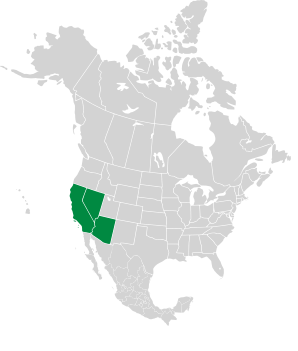
Desert lavender, a member of the mint family, is native to the southwestern United States and northern Mexico, found at elevations below 3000′ (914 m). It is a perennial, but it drops its leaves if it is too cold.
Plants: This shrub has multiple gray stems that are square in cross-section, and is 6–15′ (1.8–4.6 m) high.
Leaves: Oval, up to 2½ ⨉ 1″ (6.3 ⨉ 2.5 cm), feltlike, covered with fine hairs that make them look gray-green, with fine-toothed edges. When crushed, the leaves have a strong smell of lavender or sage with a touch of honey.
Flowers: Lavender-colored or sometimes a brighter violet. Individual flowers are ½–1″ (1.3–2.5 cm) around, with two lips and five lobes. They occur in clusters.
Fruits: Oblong nutlets, 1/32–1/16″ (1.5–2 mm) long and about 1/32″ (1 mm) wide, are brown at maturity.
Habitats: Canyons, rocky slopes, and sandy washes, at elevations below 5000′ (1.5 km) in Arizona, and below 3500′ (1 km) in California.
Online References:

2/28/2010 · Anza-Borrego Desert State Park, California · ≈ 5 × 3½″ (13 × 9.2 cm) 
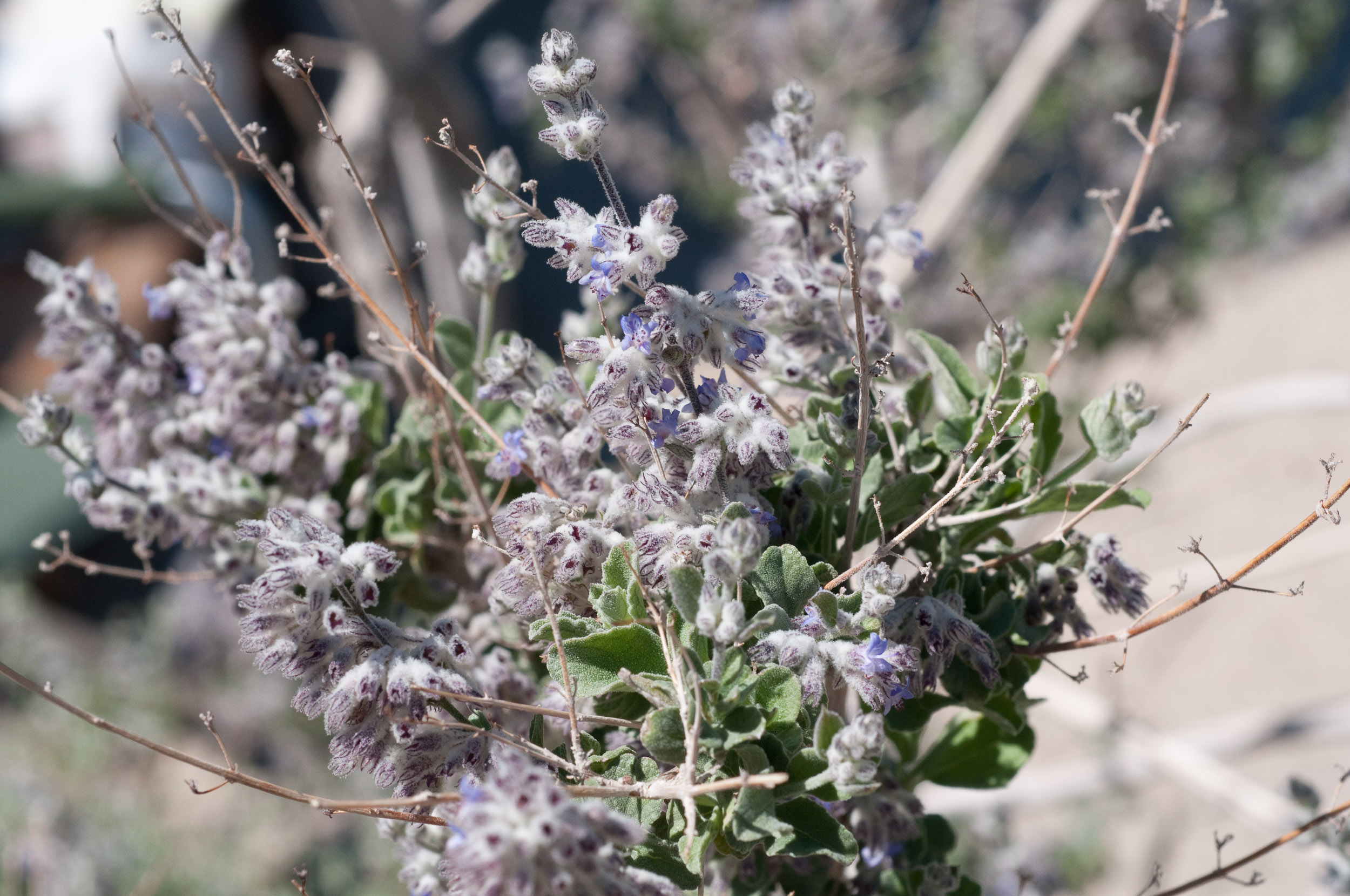
2/28/2010 · Anza-Borrego Desert State Park, California · ≈ 8 × 5″ (19 × 13 cm) 
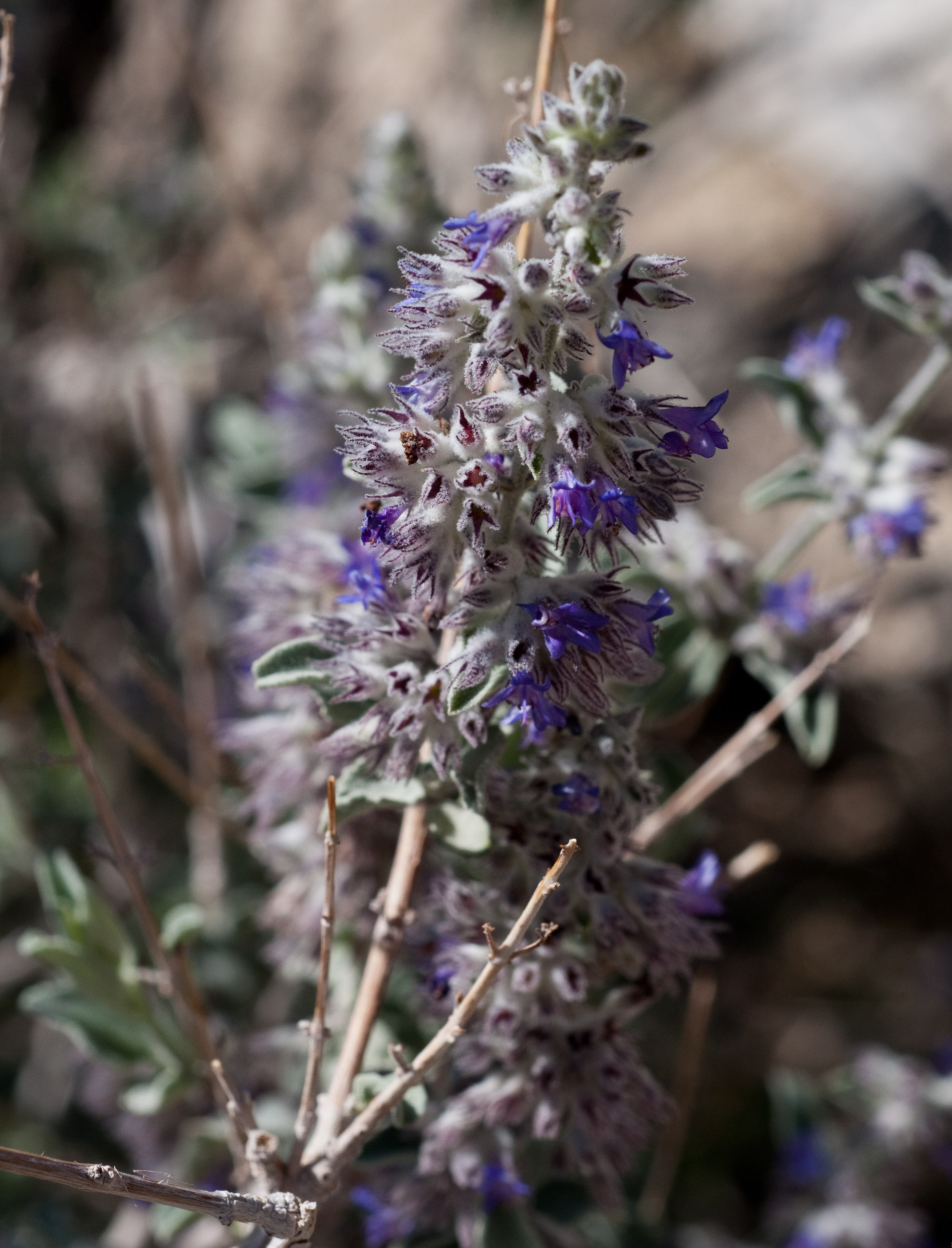
2/28/2010 · Anza-Borrego Desert State Park, California · ≈ 4 × 5″ (10 × 13 cm) 
| Kingdom | Plantae | Plants, but not fungi, lichens, or algae (from Stearn's Botanical Latin) |
| Subkingdom | Tracheobionta | Vascular plants—plants with a “circulatory system” for delivering water and nutrients |
| Division | Magnoliophyta | Flowering plants, also known as angiosperms |
| Class | Magnoliopsida | Dicotyledons—plants with two initial seed leaves |
| Subclass | Asteridae | A large class that encompasses asters |
| Order | Lamiales | Aromatic herbs and shrubs, including lavender, lilac, olive, jasmine, ash, teak, snapdragon, sesame, psyllium, garden sage, mint, basil, and rosemary |
| Family | Lamiaceae | Mint family |
| Genus | Hyptis | From the Greek huptios for “turned back,” from the lower lip position of the flower |
| Species | emoryi | After Maj. William Hemsley Emory (1811-1887), Army officer and Director of the Mexican Boundary Survey |
Hyptis emoryi description by Thomas H. Kent, not updated.

© FloraFinder.org. All rights reserved.