Cicuta douglasii (DC.) J.M. Coult. & Rose
Common water-hemlock, water hemlock, spotted water hemlock, spotted parsley, western water hemlock
This extremely toxic perennial is native throughout North America. Most botanists consider it to be the most toxic plant in North America.
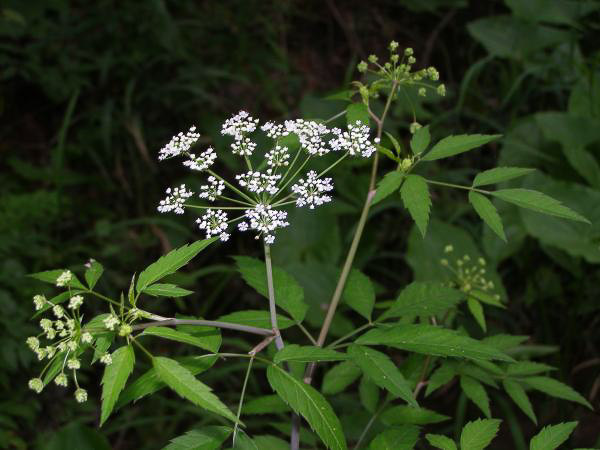
Plants: Water hemlock, a member of the carrot family, is 3–6′ (91–182 cm) in height. Stems are spotted or striped with purple, and hollow.
Leaves: Leaves are shiny, and consist of several lanceolate, serrated leaflets with pointed tips. Leaflets are ¾–4″ (2–10 cm) long, and the entire compound leaf may reach 1′ (40 cm) long.
Flowers: Small white flowers about ⅛″ (3.2 mm) across occur in small separated groups, resembling little parasols. Each tiny flower has five petals and five stamens. The “parasols” are arranged into umbrella-shaped flowerheads. The separated parasols are probably the most obvious identifying feature of this plant. Flowers appear from May to September.
Fruits: Tan fruits are several millimeters long.
Habitats: Wet meadows, roadside ditches, pond margins, open marshes, and freshwater swamps.

Leaf veins intersect with the insides of the serrations instead of the tips. 
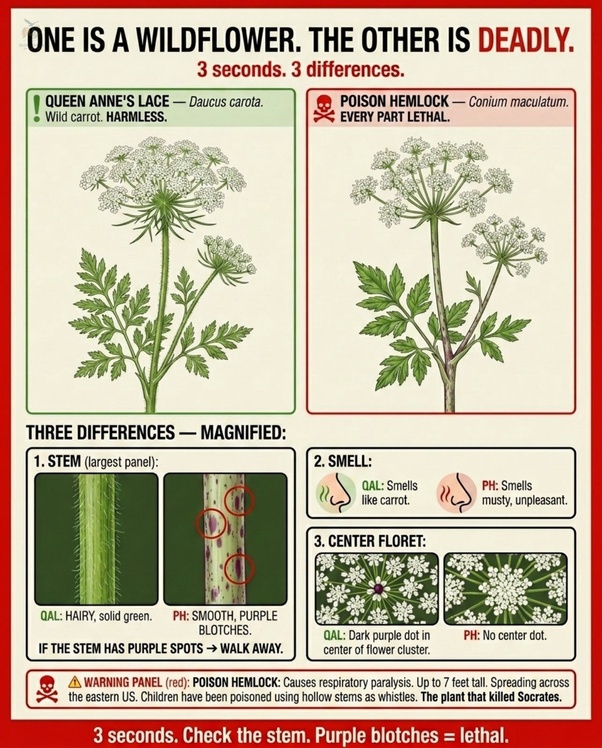
Cicuta maculata is closely similar to C. douglasii, but the former occurs throughout North America, while the latter occurs in western North America, where is it dominant. Both are closely similar; both are deadly.

 |
Similar species. |
Edibility: Poisonous  From Wikipedia:
The spotted water hemlock is
North America’s most toxic plant. All parts of this plant are
poisonous to people, as well as to livestock. When swallowed, it produces death from violent and painful
convulsions. Even very small quantities can cause death or permanent neurological damage.
From Wikipedia:
The spotted water hemlock is
North America’s most toxic plant. All parts of this plant are
poisonous to people, as well as to livestock. When swallowed, it produces death from violent and painful
convulsions. Even very small quantities can cause death or permanent neurological damage.
Online References:
Cicuta maculata L. var. californica (A. Gray) B. Boivin
1/5/2026 · By Jacquelyn Boyt 
| Kingdom | Plantae | Plants, but not fungi, lichens, or algae (from Stearn's Botanical Latin) |
| Subkingdom | Tracheobionta | Vascular plants—plants with a “circulatory system” for delivering water and nutrients |
| Division | Magnoliophyta | Flowering plants, also known as angiosperms |
| Class | Magnoliopsida | Dicotyledons—plants with two initial seed leaves |
| Subclass | Asteridae | A large class that encompasses asters |
| Order | Apiales | Includes carrots, celery, parsley, and ivy |
| Family | Apiaceae | Carrot or parsley family, also includes angelica, anise, caraway, celery, chervil, cicely, coriander/cilantro, cumin, dill, fennel, hemlock, lovage, Queen Anne’s Lace, parsnip |
| Genus | Cicuta | An ancient Latin name of poison hemlock |
| Species | douglasii | Named for David Douglas (1798-1834), Scottish collector who was sent to North America first in 1823 and then two more times by the Horticultural Society of London to collect plants that could grow in English gardens0 |
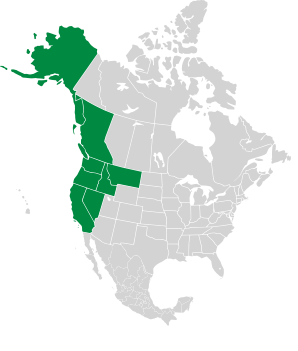
Cicuta douglasii description by Thomas H. Kent, not updated.

© FloraFinder.org. All rights reserved.