Carex platyphylla Carey
Broadleaved sedge
Similar species
Carex platyphylla
Carex plantaginea



|
Carex platyphylla Carey Broadleaved sedge Similar species | ||
| You are here Carex platyphylla |
Carex plantaginea |
|
|---|---|---|
| Common Name | |
|
| Plant | Dense tufts have stems up to 1′ (38 cm) tall. The base of the plant is white to light brown. | Grows in dense tufts (cespitose). Culms (stems) are erect or arching. They are hairless and green. Leaves are all basal, emerging from a red-purple sheath. Since the leaves are evergreen, plants often appear beat-up in the spring. |
| Leaves | Lanceolate, very wide for sedges, with a whitish, waxy coating, up to 9″ long ⨉ ⅜–1″ wide (22 ⨉ 1.1–2.8 cm). They are somewhat W-shaped in cross section. | Leaves are evergreen, hairless, with a set of three parallel ribs, 6–17 ⨉ ¼–1¼″ (14–42 cm ⨉ 8–32 mm). Viewed in cross section, the leaves have a zig-zagged shape. They often have a rippled appearance, hence the common name “seersucker.” Leaves on the culms are smaller, reddish purple, and tubular. |
| Flowers | Inflorescences have two to four spikes. Pistillate (female) spikes typically have 2-4 perigynia per spike, with the spike nestled in a bract. The perigynia are 3-sided in cross-section, and 1/16–⅛″ (3–3.2 mm) long. | Each culm contains 2-4 pistillate (female) spikes and is topped by a single staminate (male) spike. The female spikes are ½–1½″ (1.3–3.8 cm) long, and roughly cylindrical. The male spike is reddish-purple, and up to ¾″ (1.9 cm) long. Blooming begins in mid-spring. |
| Fruit | Achenes are 1/16–⅛ ⨉ ~1/16″ (2.8–3 ⨉ 1.6–1.8 mm). | Achenes are about 1/16″ (2.5 mm) long, ovoid, and 3-angled. |
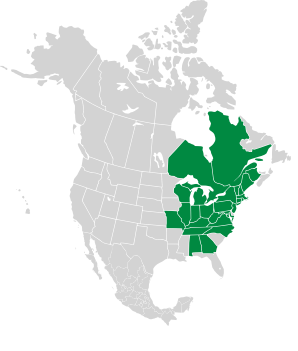
| Range/ Zones |
|
|
| Habitats | Rich, mesic hardwood forests, and rocky slopes. | Rich deciduous forests, on wooded slopes and ravines, in calcerous soils. It is often associated with basswood and ferns. |
Carex platyphylla description by Thomas H. Kent, not updated.
© FloraFinder.org. All rights reserved.