Carex comosa Boott
Bristly sedge, longhair sedge
Similar species
Carex comosa
Carex pseudocyperus


|
Carex comosa Boott Bristly sedge, longhair sedge Similar species | ||
| You are here Carex comosa |
Carex pseudocyperus |
|
|---|---|---|
| Common Name | |
|
| Plant | These perennials form large tufts 2–3½′ (60–106 cm) tall. Culms are light green and three-angled. | Up to 3′ (1 m) tall. Stems feel rough to the touch, and are roughly triangular (“trigonous”) in cross-section. |
| Leaves | Alternate, and appearing along the length of the culm (vs. mostly basal in many Carex species). Leaves are 8–18″ long ⨉ ⅛–⅝″ wide (20–45 cm ⨉ 6–17 mm). Each blade typically has a central furrow. | ⅛–½″ (4–13 mm) wide, hairless, flat to W-shaped in cross-section. They are basal or alternate. |
| Flowers | Inflorescence is 1½–14″ (4–35 cm) long. The uppermost spike is (usually) staminate (male), narrower and disheveled in appearance, up to 3″ (7.5 cm) long, brown, with a bract like a leaf blade that extends far beyond the spike. This spike has carpellate scales 1/16–⅜ ⨉ ~1/32″ (2.8–12 ⨉ 0.4–1 mm), with long awns. Lower spikes—three to six per stem—are pistillate (female). They are neat stiff cylinders resembling bottle brushes, ⅞–3 ⨉ ⅜–⅝″ (2.5–7.5 ⨉ 1.2–1.8 cm) in size. They are comprised of perigynia 3/16–5/16 ⨉ 1/32–1/16″ (6.2–8.7 ⨉ 1.1–1.8 mm) in size, tapering to a long beak with two sharp, stiff, spreading teeth. Flowers appear from late spring to early summer. | Inflorescences are 1½–6″ (4–15 cm) long. Each is topped by a single staminate (male) spike (sometimes with some pistillate flowers at the tip). The spike is up to 3″ (7.6 cm) long, with a leaflike bract below that is much longer than the spike. This spike is comprised of carpellate scales 1/16–¼″ ⨉ 11.8–23.6 mils (2.5–8.6 ⨉ 0.3–0.6 mm). Below the staminate spike are 2 to 6 pistillate spikes, cylindrical, ⅞–3″ long ⨉ ¼–⅜″ wide (2.5–7.5 cm ⨉ 8–12 mm). They are erect at first, drooping as the plant matures. They are comprised of perigynia ⅛–3/16 ⨉ 1/32–1/16″ (3.4–6.1 ⨉ 1–1.7 mm) in size. Each is tipped by two single, sharp teeth. |
| Fruit | Achenes are 1/32–1/16″ (1.5–2 mm) in size. | Achenes are 3-sided, oval-elliptic, becoming light brown. Fruits appear from June to July. |
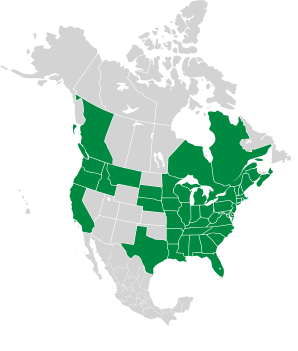
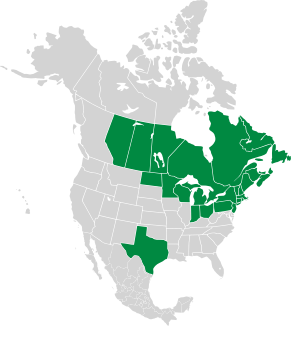
| Range/ Zones |
|
|
| Habitats | Wet, mucky, or slightly sandy soil, in full sun to light shade. | Wet sunny areas—shores, riverbanks, marshes, swales, ditches. |
Carex comosa description by Thomas H. Kent, not updated.
© FloraFinder.org. All rights reserved.