Baptisia australis (L.) R. Br.
Blue false indigo, false indigo, blue wild indigo
Blue false indigo vs. real indigo
Baptisia tinctoria
Baptisia australis


|
Baptisia australis (L.) R. Br. Blue false indigo, false indigo, blue wild indigo Blue false indigo vs. real indigo | ||
Baptisia tinctoria |
You are here Baptisia australis |
|
|---|---|---|
| Common Name | |
|
| Plant | Wild indigo is multiply branched and somewhat unruly, sometimes matted in appearance, 1–3′ (30–91 cm) high. In Martha’s Vineyard, MA, it forms a ball-shaped cluster that breaks off when it dries out in the fall and rolls around like tumbleweed. | 3–5′ (1–1.5 m) high, and about 1½–3′ (50–100 cm) around. When broken, the hairless stems secrete a fluid that turns dark purple on contact with air. (It is this reaction, not the flowers, that resulted in its use for dye.) |
| Leaves | alternate, silvery green, in triplets similar to clover. Each leaflet is ¼″ (6.3 mm) long. | In groups of three, each about 1″ (2.5 cm) long, and green, bluish green, or grayish green. |
| Flowers | Clusters of yellow, pea-like flowers appear in July. | It’s pea-like flowers, appearing at or in a spike near the top, vary in color from light blue to dark purple. |
| Fruit | Small inflated seed pods turn black when ripe. Seeds rattling around in the ripe pods prompted the common name “rattleweed.” | Fruits are bluish-black hard pods ⅞–3 ⨉ ⅜–⅞″ (2.5–7.5 ⨉ 1.3–2.5 cm) in size. Seeds rattling in the dried seedpods have tricked more than one person into thinking a rattlesnake is nearby. |
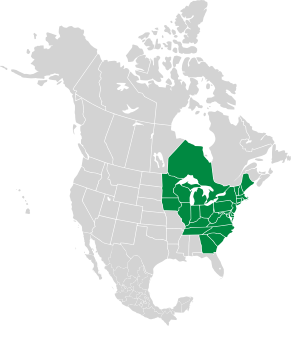
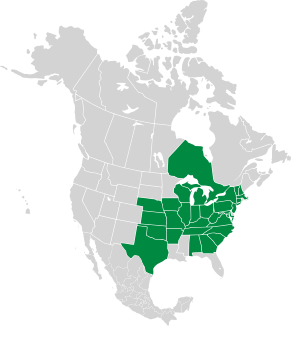
| Range/ Zones |
|
|
| Habitats | Dry open woods and clearings. | Rich woods, thickets, meadows, stream banks. |
Baptisia australis description by Thomas H. Kent, not updated.
© FloraFinder.org. All rights reserved.