Aloe massawana Reynolds
Very similar species
Aloe vera
Aloe massawana


|
Aloe massawana Reynolds Very similar species | ||
Aloe vera |
You are here Aloe massawana |
|
|---|---|---|
| Common Name | |
|
| Plant | Medicinal aloe is by far the best known of the Aloe species, widely cultivated for its medicinal properties. Plants have short woody stems. | Plants are on the ground, with short stems or no discernible stems. They form clumps 1½–2′ (45–60 cm) tall and up to 9½′ (3 m) in diameter. |
| Leaves | Compact rosettes are 2–3′ (60–100 cm) tall. Leaves are alternate, 4–20″ long ⨉ ⅜–2½″ broad (10–50 ⨉ 1–7 cm), wider at the base and tapering to a tip. They are bluish or gray-green, occasionally mottled with purple or white spots, sometimes serrated with small teeth on leaf edges. | Leaves occur in rosettes as with other aloes and are green to gray-green, with thorny edges. Each leaf is 1½–3′ (50–90 cm) long, and 2–4″ (6–10 cm) wide at the base, tapering to a poiint. Leaves have small teeth that may be soft or firm. |
| Flowers | Inflorescences appear on a spike 3–5′ (1–1.5 m) tall. Usually the spike has scale-like bracts. Racemes of flowers are cylindrical, yellow or orange, with tubular corollas ¾–1″ (2–3 cm) long. |
|
| Fruit | Capsules are somewhat elongated, usually producing no seeds. It spreads primarily by offsets. | Ovoid dehiscent capsules are ¾ ⨉ ⅜″ (2 ⨉ 1.1 cm). They dry and split, releasing seeds. |
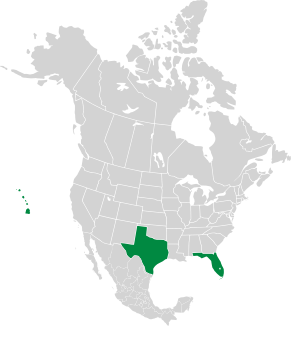
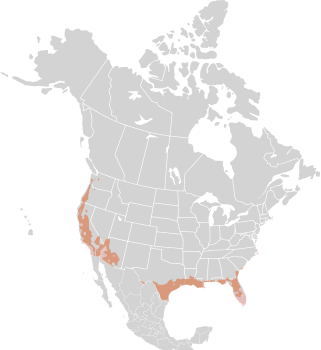
| Range/ Zones |
|
|
| Habitats | Hammocks and sandy areas in arid climates. | Right on the beach front in the salt spray zone on coral outcrops. Also recorded in sandy soils, in grass and open thickets near the sea shore. |
Aloe massawana description by Thomas H. Kent, not updated.
© FloraFinder.org. All rights reserved.