FloraFinder uses cookies only for correct operation. More info. Okay
Tetracoccus hallii Brandegee
Hall’s shrubby-spurge, Hall’s tetracoccus, Hall’s purple bush
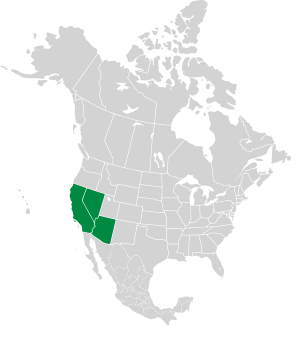
Hall’s purple bush is native to California and a couple of nearby states. It is abundant
in Joshua Tree National Park.
Plants: A bushy, heavily branched shrub up to 6½′ (2 m)
in size.
Leaves: Tiny leathery alternate leaves are
green, reddish, or purple. They are spread sparsley along the gray branches, sometimes in clumps.
Leaves are shaped like teardrops, 1/16–⅜″ (2–12 mm)
long, and
attached directly to the branches.
Flowers: Male (staminate) plants
produce bundles of 2-20 flowers with 4-6 rounded sepals and 4-8 stamens.
Female (pistillate) plants produce single flowers or groups of up to 6.
They bloom principally from March to May.
Fruits: Brown, roughly ovoid, and
¼–⅜″ (8–12 mm) long.
Habitats: Desert slopes and dry washes on igneous
substrates, at elevations of 98–3937′ (30–1200 m).
Halliophytum fasciculatum auct. non (S. Watson) I.M. Johnst. Halliophytum fasciculatum (S. Watson) I.M. Johnst. var. hallii (Brandegee) McMinn Halliophytum hallii (Brandegee) I.M. Johnst. Tetracoccus fasciculatus auct. non (S. Watson) Croizat Tetracoccus fasciculatus (S. Watson) Croizat var. hallii (Brandegee) Dressler
A family of subtropical to tropical flowering plants, found in New Guinea, Australia, New Caledonia, Madagascar, continental Africa, and tropical America
“four seeds,” from the Greek tetra, “four,” and kokkos, “a kernel, grain, or berry,” (from Edmund Jaeger’s A Source-Book of Biological names and Terms) because of the four-lobed or four-seeded ovary in the original species, T. dioicus. My original information followed Philip Munz, who used the word kakkos for “fruit,” but I have been kindly informed by Dr. Stavros Kakkos of my mistake, and in checking other sources find the proper word source to have been kokkos. Thank you, Dr. Kakkos.
Species
hallii
After Elihu Hall (1822-1882), “a farmer with a great interest in botany, collected 300 of the original specimens and had a personal collection of 10,000 specimens”