Quercus palustris Münchh.
Pin oak
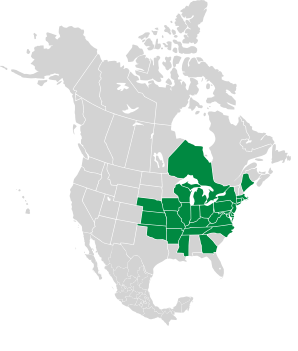
Pin oak is native to the northeastern United States and southeastern Canada.
Plants: 59–72′ (18–22 m) tall, with a trunk up to 3′ (1 m) around. Bark is smooth and gray. The tree’s crown is roughly pyramidal, with the curious property that upper branches are ascending, mid-level branches roughly straight, and lower branches descending. In forests, lower branches may die off, breaking and leaving behind projections, hence the name “pin oak.”
Leaves: 1¾–6 ⨉ 1¾–4½″ (5–16 ⨉ 5–12 cm), with 5-7 lobes. Each lobe has 5-7 teeth. The sinuses—indented areas—are U-shaped and very deep. Leaves are hairless, apart from a distictinve tuft of pale orange-brown down on the lower leaf surface where lobe veins join the central vein. Leaves are glossy and dark green, becoming deep red in the fall.
Flowers: Yellow to greenish yellow staminate (male) and pistillate (female) catkins appear on the same tree (“monoecious“) in the spring,
Fruits: Acorns are rounded, to ½″ (1.3 cm), with caps that cover ¼ to ⅓ of the fruit. Acorn production begins when the three is 15-20 years old.
Habitats: Valleys, floodplains, and stream margins.
Online References:

10/24/2016 · Whitetail Woods, Littleton, Massachusetts · ≈ 5 × 8″ (13 × 20 cm) 

10/24/2016 · Whitetail Woods, Littleton, Massachusetts · ≈ 7 × 4½″ (18 × 12 cm) 
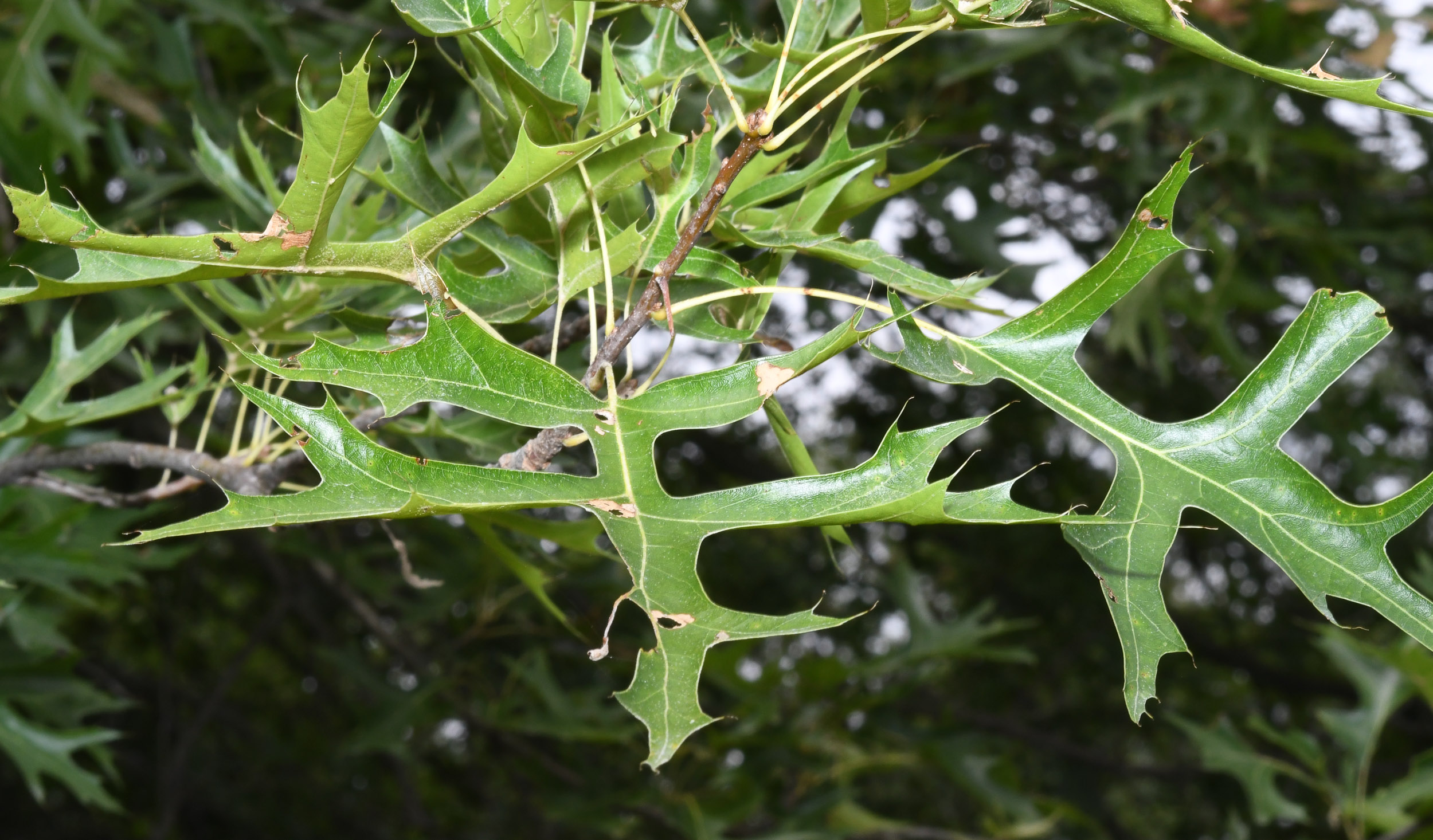
7/27/2016 · State Arboretum of Virginia, Boyce, Virginia 

10/24/2016 · Whitetail Woods, Littleton, Massachusetts · ≈ 6 × 4″ (16 × 11 cm) 
| Kingdom | Plantae | Plants, but not fungi, lichens, or algae (from Stearn's Botanical Latin) |
| Subkingdom | Tracheobionta | Vascular plants—plants with a “circulatory system” for delivering water and nutrients |
| Division | Magnoliophyta | Flowering plants, also known as angiosperms |
| Class | Magnoliopsida | Dicotyledons—plants with two initial seed leaves |
| Subclass | Rosidae | Roses, legumes, proteas, dogwoods, hydrangeas, mistletoes, euphorbias, grapes, many more |
| Order | Fagales | Birch, she-oak, beech, walnut, bayberry, others |
| Family | Fagaceae | Beech familhy |
| Genus | Quercus | Latin for “oak” |
| Species | palustris | Growing in marshes |
Quercus palustris description by Thomas H. Kent, not updated.

© FloraFinder.org. All rights reserved.