Quercus grisea Liebm.
Gray oak, scrub oak, shin oak
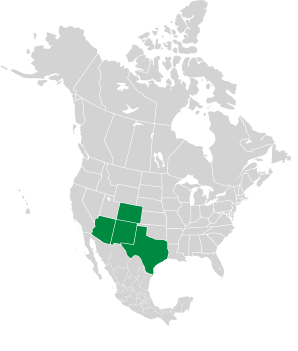
Gray oak is native to mountainous regions of the southwestern United States and northern Mexico. Wikipedia reports: “It hybridizes with four other oak species where the ranges overlap, the Arizona white oak (Q. arizonica), the Gambel oak (Q. gambelii), the Mohr oak (Q. mohriana), and the sandpaper oak (Q. pungens).”
Plants: A tree or multistemmed shrub, with trees reaching up to 66′ (20 m) in height, and a trunk up to 2′ (60 cm) in diameter.
Leaves: Alternate, leathery, ¾–3″ (2–7.6 cm) long, elliptical to ovate, and either untoothed or with a few coarse teeth. Leaves are grayish green above and felted beneath, due fine hairs. Leaves are evergreen, or drought deciduous.
Flowers: Male catkins are yellowish-green. Female flowers are in small spikes in the leaf axils.
Fruits: Acorn cups are scaly, covering about half of each acorn. Acorns are single or paired. Each acorn is about ½″ (1.3 cm) long.
Habitats: In valleys and on ridges, on rocky slopes and on the banks of streams, at elevations of 3937–8858′ (1.2–2.7 km).
 |
Similar species. |
Online References:

8/26/2014 · Sandstone Bluffs, Rte. 117, El Malpais National Monument, New Mexico · ≈ 9 × 7″ (23 × 16 cm) 
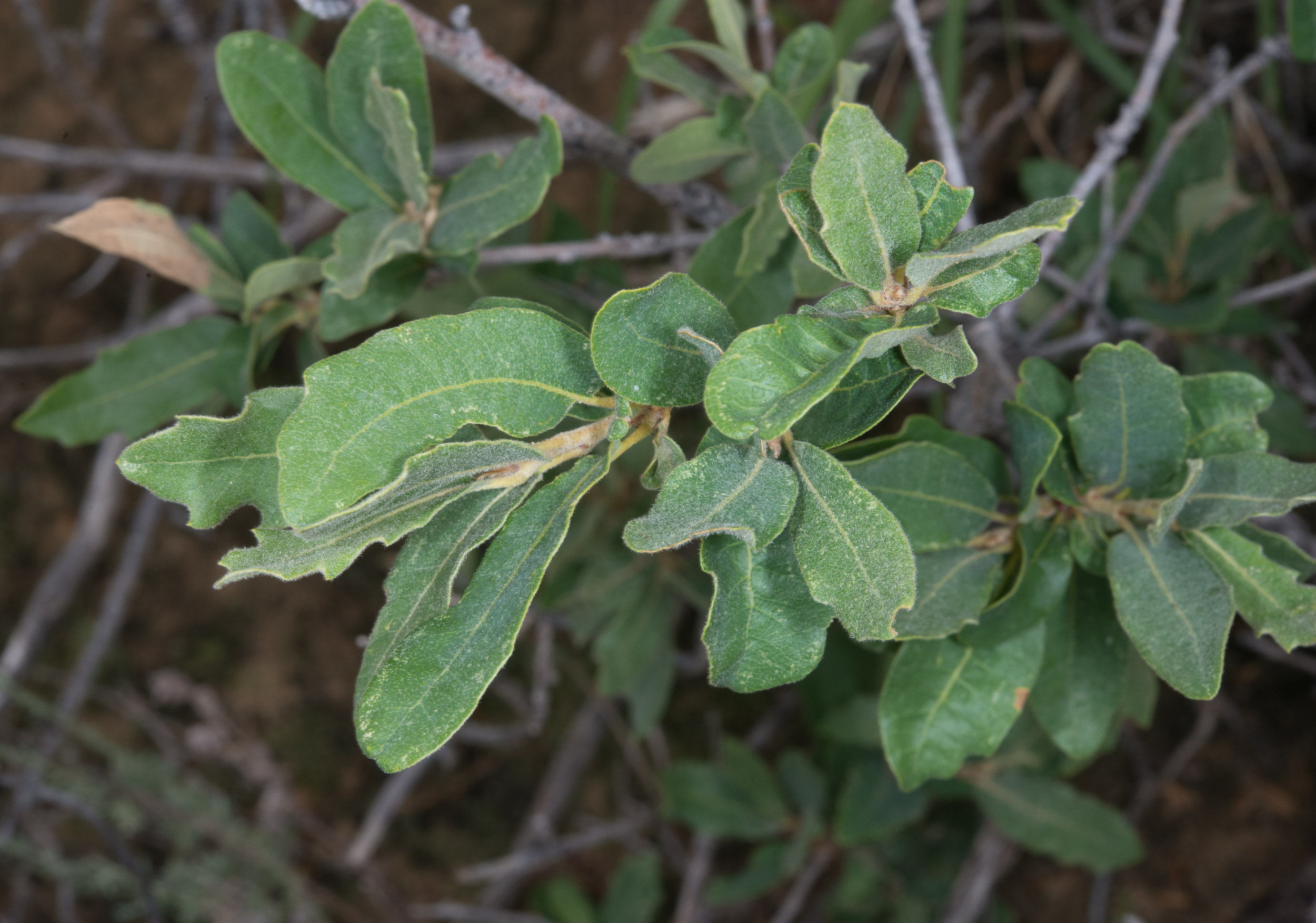
8/26/2014 · Sandstone Bluffs, Rte. 117, El Malpais National Monument, New Mexico · ≈ 7 × 4½″ (17 × 12 cm) 
| Kingdom | Plantae | Plants, but not fungi, lichens, or algae (from Stearn's Botanical Latin) |
| Subkingdom | Tracheobionta | Vascular plants—plants with a “circulatory system” for delivering water and nutrients |
| Division | Magnoliophyta | Flowering plants, also known as angiosperms |
| Class | Magnoliopsida | Dicotyledons—plants with two initial seed leaves |
| Subclass | Rosidae | Roses, legumes, proteas, dogwoods, hydrangeas, mistletoes, euphorbias, grapes, many more |
| Order | Fagales | Birch, she-oak, beech, walnut, bayberry, others |
| Family | Fagaceae | Beech familhy |
| Genus | Quercus | Latin for “oak” |
| Species | grisea | Gray |
Quercus grisea description by Thomas H. Kent, not updated.

© FloraFinder.org. All rights reserved.