Lactuca spicata (Lam.) Hitchc. var. integrifolia (Torr. & A. Gray) Britton
Mulgedium spicatum auct. non (Lam.) Small
Mulgedium spicatum (Lam.) Small var. integrifolium (Torr. & A. Gray) Small
Lactuca biennis (Moench) Fernald
Tall blue lettuce
This wild lettuce is native to eastern North America, and has been introduced to much of the rest of the continent as well. It is called tall blue lettuce because its flowers are blue. And it’s tall.
Plants: Tall blue lettuce grows up to 6′ (1.8 m) high.
Leaves: Deeply divided, like those of dandelions, but while dandelion leaves are roughly the same width along their length, these are more triangular in overall shape. They are up to 1′ (30 cm) long and 6″ (15 cm) wide at the base, tapering to sharp tips. Leaves are hairy, undersides more so.
Flowers: Blue, about ¼–½″ (6.3–12 mm) across, in crowded clusters at the top. Each flower is a composite flower, but with many whitish to light blue ray florets but no disc florets.
Fruits: Mottled achenes ⅛″ (5 mm) long.
Habitats: Redwood forest, wetlands.
 |
Some wild lettuce species. |
There are two similar species of wild lettuce with blue flowerheads. Lactuca floridana, florida lettuce or false lettuce, reaches 9′ (2.7 m) in height, and has loose clusters of blue, sometimes whitish flowers. L. pulchella, large-flowered blue lettuce, has fewer, larger flowers, and its foliage is covered with a waxy, whitish bloom. The blue flowers look similar in shape and color to those of wild chicory, but the foliage is very different.

From Britton, Nathaniel Lord, and Brown, Addison, An illustrated flora of the northern United States, Canada and the British Possessions, 1913. 
Online References:
References:

9/5/2010 · Nashua River Rail Trail, near Nashoba Hospital, Ayer, Massachusetts · ≈ 10 × 14″ (26 × 35 cm)  ID is uncertain


7/17/2013 · Near Nashua River Boat Ramp, Groton, Massachusetts 

6/3/2016 · Nashua River Rail Trail, East Pe 

8/18/2010 · J. Harry Rich Woods, off Nod Rd., Groton, Massachusetts · ≈ 3½ × 5″ (9.2 × 13 cm) 

8/4/2009 · Near Nashoba Hospital, Ayer, Massachusetts ID is uncertain 

10/5/2023 · Quill Hill, Rangeley, Maine 

9/1/2018 · Bates Land and Blackman Land, Groton Conservation Trust, Groton, Massachusetts · ≈ 6 × 10″ (16 × 24 cm) 

6/3/2016 · Nashua River Rail Trail, East Pe 

9/1/2018 · Bates Land and Blackman Land, Groton Conservation Trust, Groton, Massachusetts · ≈ 10 × 15″ (26 × 39 cm) 

6/5/2012 · Nashua River Rail Trail, Groton Center, Groton, Massachusetts · ≈ 1 × 1½′ (34 × 52 cm) 

10/5/2023 · Quill Hill, Rangeley, Maine 

8/2/2012 · Nashua River Rail Trail, near Nashoba Hospital, Ayer, Massachusetts 

8/18/2010 · J. Harry Rich Woods, off Nod Rd., Groton, Massachusetts · ≈ 7 × 4½″ (17 × 11 cm) 

8/14/2015 · Roost Trail, Grafton Notch State Park, Newry, Maine · ≈ 4½ × 7″ (11 × 16 cm) 

8/18/2010 · J. Harry Rich Woods, off Nod Rd., Groton, Massachusetts · ≈ 3 × 4½″ (7.9 × 11 cm) 

8/14/2015 · Roost Trail, Grafton Notch State Park, Newry, Maine · ≈ 7 × 10″ (16 × 25 cm) 

7/27/2009 · Nashua River Rail Trail, Groton, Massachusetts · ≈ 2 × 3′ (65 × 98 cm) ID is uncertain 

8/2/2012 · Nashua River Rail Trail, near Nashoba Hospital, Ayer, Massachusetts 

8/18/2010 · J. Harry Rich Woods, off Nod Rd., Groton, Massachusetts · ≈ 5 × 8″ (13 × 19 cm) 

6/11/2014 · Conservation Area near Potanipo Pond, Brookline, New Hampshire · ≈ 12 × 8″ (31 × 21 cm) 

6/11/2014 · Conservation Area near Potanipo Pond, Brookline, New Hampshire · ≈ 15 × 10″ (37 × 25 cm) 
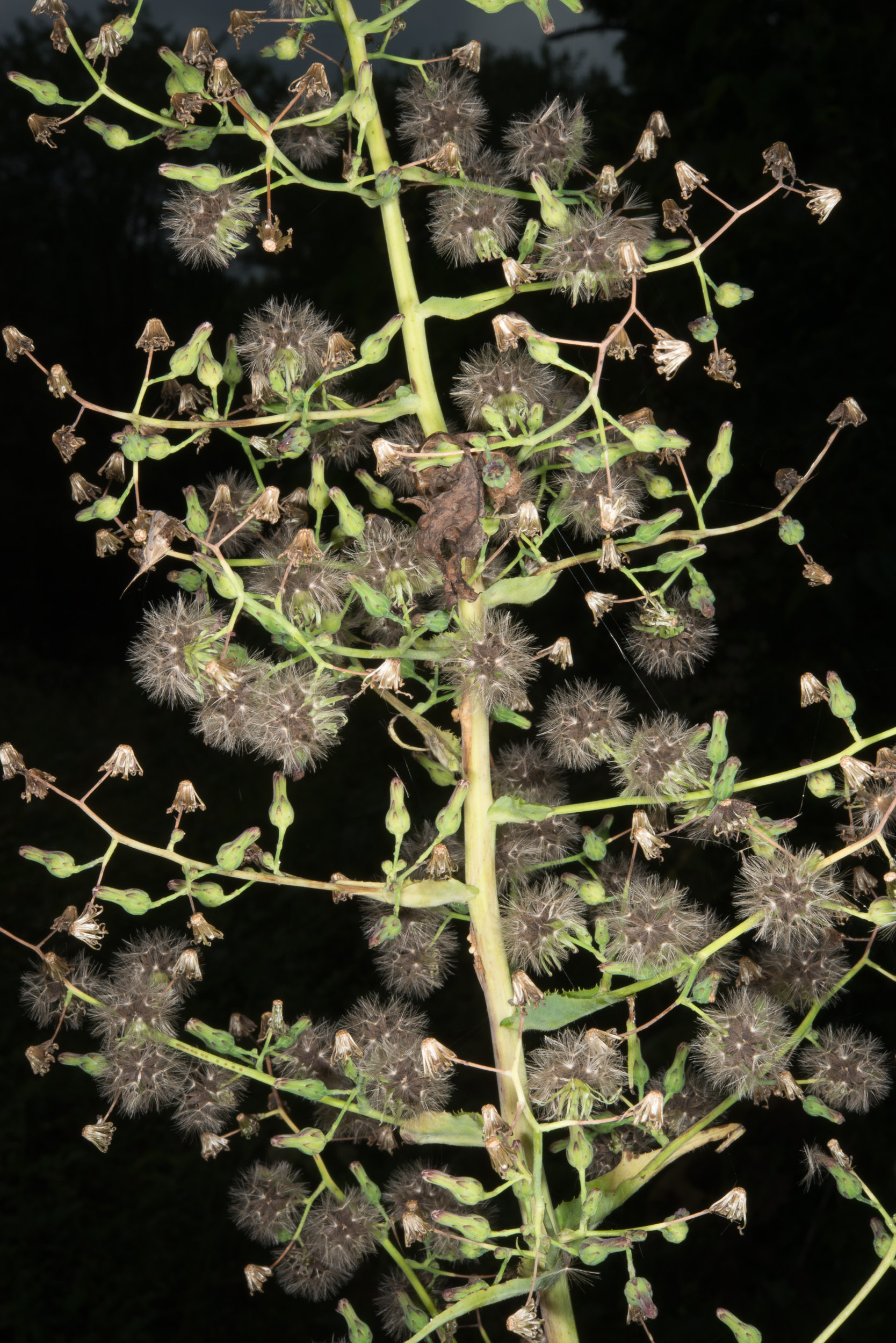
9/10/2014 · Acton Arboretum, Acton, Massachusetts · ≈ 8 × 12″ (21 × 31 cm) 
| Kingdom | Plantae | Plants, but not fungi, lichens, or algae (from Stearn's Botanical Latin) |
| Subkingdom | Tracheobionta | Vascular plants—plants with a “circulatory system” for delivering water and nutrients |
| Division | Magnoliophyta | Flowering plants, also known as angiosperms |
| Class | Magnoliopsida | Dicotyledons—plants with two initial seed leaves |
| Subclass | Asteridae | A large class that encompasses asters |
| Order | Asterales | Flowering plants with a central disk flower and surrounding petals, like daisies |
| Family | Asteraceae | The aster family, which also includes daisies and sunflowers; from the Greek ἀστήρ, “star,” for the star-shaped flowers |
| Genus | Lactuca | From lacta, Latin for “milk,” referring to the milky sap in stem, and a root word for lactic acid |
| Species | biennis | Biennial, completing the life cycle in two growing seasons, usually blooming and fruiting in the second |
Lactuca biennis description by Thomas H. Kent, not updated.

© FloraFinder.org. All rights reserved.
