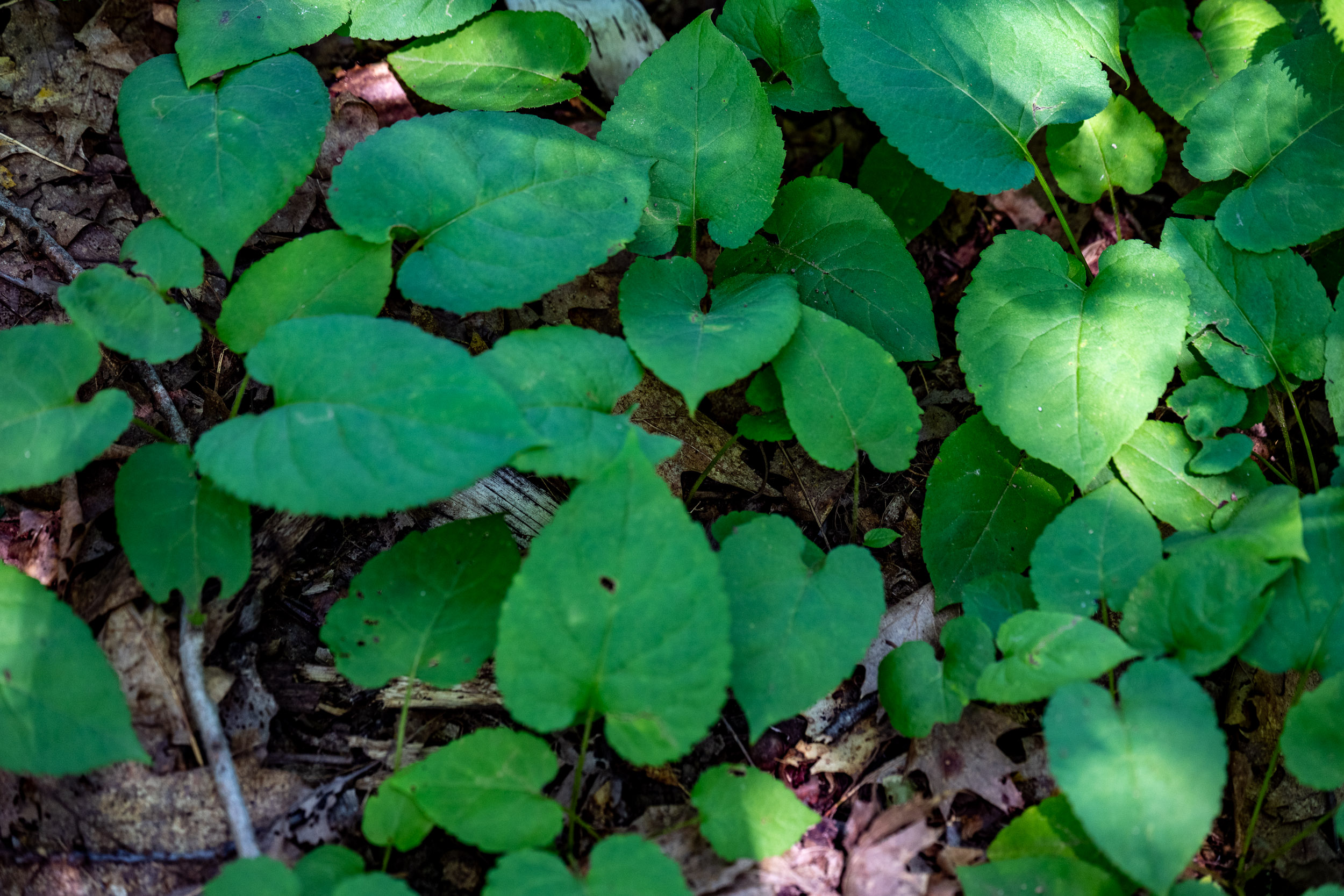
Plants: These perennials begin as a basal rosette of
leaves about 6–12″ (15–30 cm) in size. They reach heights of 3′ (91 cm) rarely, but are usually half that.
They often form colonies of basal leaves with no flowers.
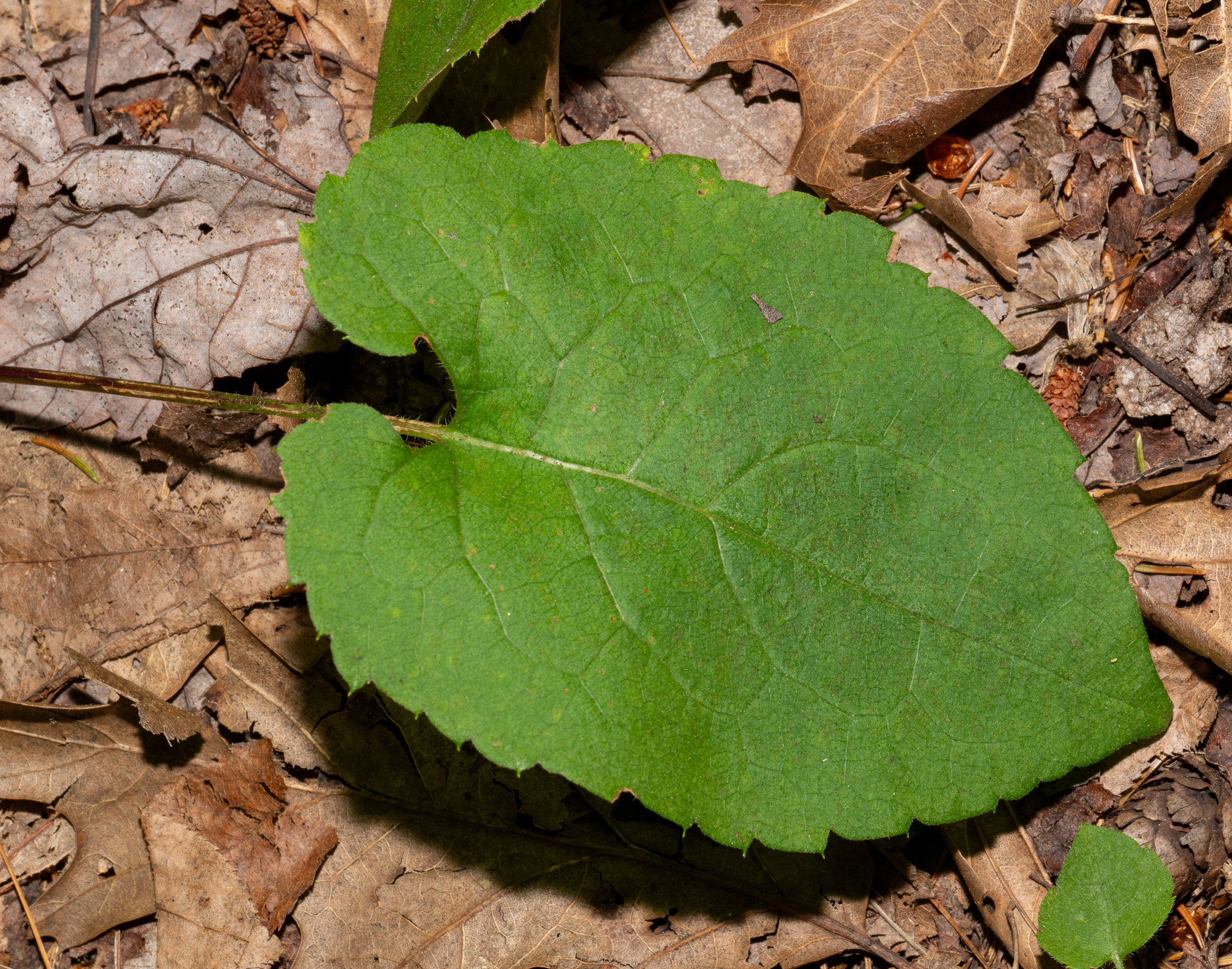
Leaves: Basal leaves are up to
8 ⨉ 6″ (20 ⨉ 15 cm), and cordate (heart-shaped), simple (unlobed),
rough-textured,
on petioles up to 6″ (15 cm) long.
Upper leaves become progressively smaller and more ovate in shape.
Stems are light green, sometimes tinged with red, with few if any branches and alternate leaves.
Leaves are coarsely serrated or crenate, and leaf bases are winged, the wings becoming
more prominant further up the stalk.
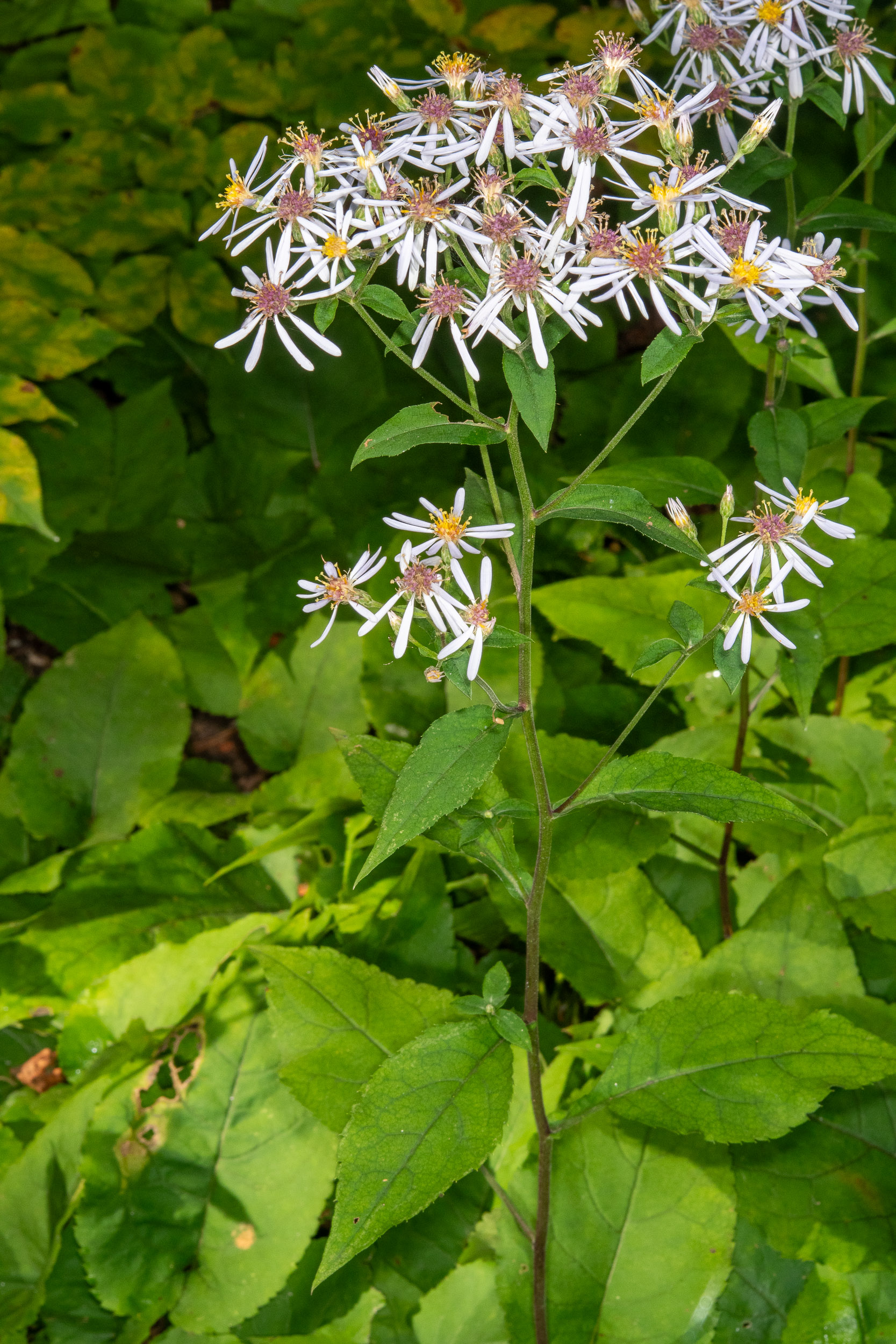
Flowers: Corymbs of flowerheads are about
3–8″ (7.6–20 cm) around.
Each flower is a composite flower,
with violet to pale blue ray flowers and a center comprised of yellow disc flowers that darken to
reddish brown as they age. They are on short-haired pedicels up to 1½″ (3.8 cm) long.
Clusters of up to 90 flowers are known, but 11 to 50 are more common.
Flowers appear from July to October.
Fruits: Dry seeds—cypselae—have small tufts of pappi,
yellow-brown to orange-brown, for wind distribution.
Habitats: Moist to dry soils in hemlock–northern hardwood, beech–maple,
pine, or Appalachian spruce–fir forests. It occurs in thickets, clearings or along roadsides, in partial shade.
Aster ianthinus Burgess Aster macrophyllus L. Aster macrophyllus L. var. apricensis Burgess Aster macrophyllus L. var. excelsior Burgess Aster macrophyllus L. var. ianthinus (Burgess) Fernald Aster macrophyllus L. var. pinguifolius Burgess Aster macrophyllus L. var. sejunctus Burgess Aster macrophyllus L. var. velutinus Burgess Aster multiformis Burgess Aster nobilis Burgess Aster riciniatus Burgess Aster roscidus Burgess Aster violaris Burgess