Phyllocactus darrahii K. Schumann 1903
Epiphyllum darrahii (K. Schumann) Britton & Rose 1913
Epiphyllum anguliger (Lemaire) D. Don 1855
Rickrack cactus, moon cactus, queen of the night, fishbone cactus, zig zag cactus
Moon cacti are native to central and southern Mexico. The common names “moon cactus” and “queen of the night” refer are because it blooms at night (though flowers may last into the next day). Rickrack cactus refers to the unusual leaflets.
Plants: Multiple stems are up to 3′ (1 m) long. Main stems are woody, usually rounded, with branching alternate flattened “leaflets.” These plants more closely resemble ferns than most cacti. They are epiphytes, growing atop other plants without harming them.
Flowers: 6–7 ⨉ 4–5″ (15–18 ⨉ 10–13 cm) in diameter, with an inner white or pale yellow flower and an outer orange-bronze sepals. They have a strong, sweet scent.
Fruits: 1–1½″ long ⨉ ¾″ in diameter (3–4 ⨉ 2 cm). They are ovoid and brownish, greenish, or yellowish. They resemble gooseberries. Inside, they look a bit like kiwi fruits, with green pulp and small black seeds.
Habitats: Evergreen forests, at elevations of 3609–5906′ (1.1–1.8 km).
Edibility: Fruit is edible.

From Paxton’s Flower Garden, volume 1, plate 34, by John Lindley and Joseph Paxton, drawing by L. A. L. Constans, 1853. 
References:
Online References:
FredMiranda.com (great photos!)
YouTube (a video of the flowers)

4/6/2011 · Howard Peters Rawlings Conservatory & Botanic Gardens, Druid Hill Park, Baltimore, Maryland · ≈ 1 × 1½′ (34 × 52 cm) 

4/6/2011 · Howard Peters Rawlings Conservatory & Botanic Gardens, Druid Hill Park, Baltimore, Maryland · ≈ 1 × 1½′ (34 × 52 cm) 
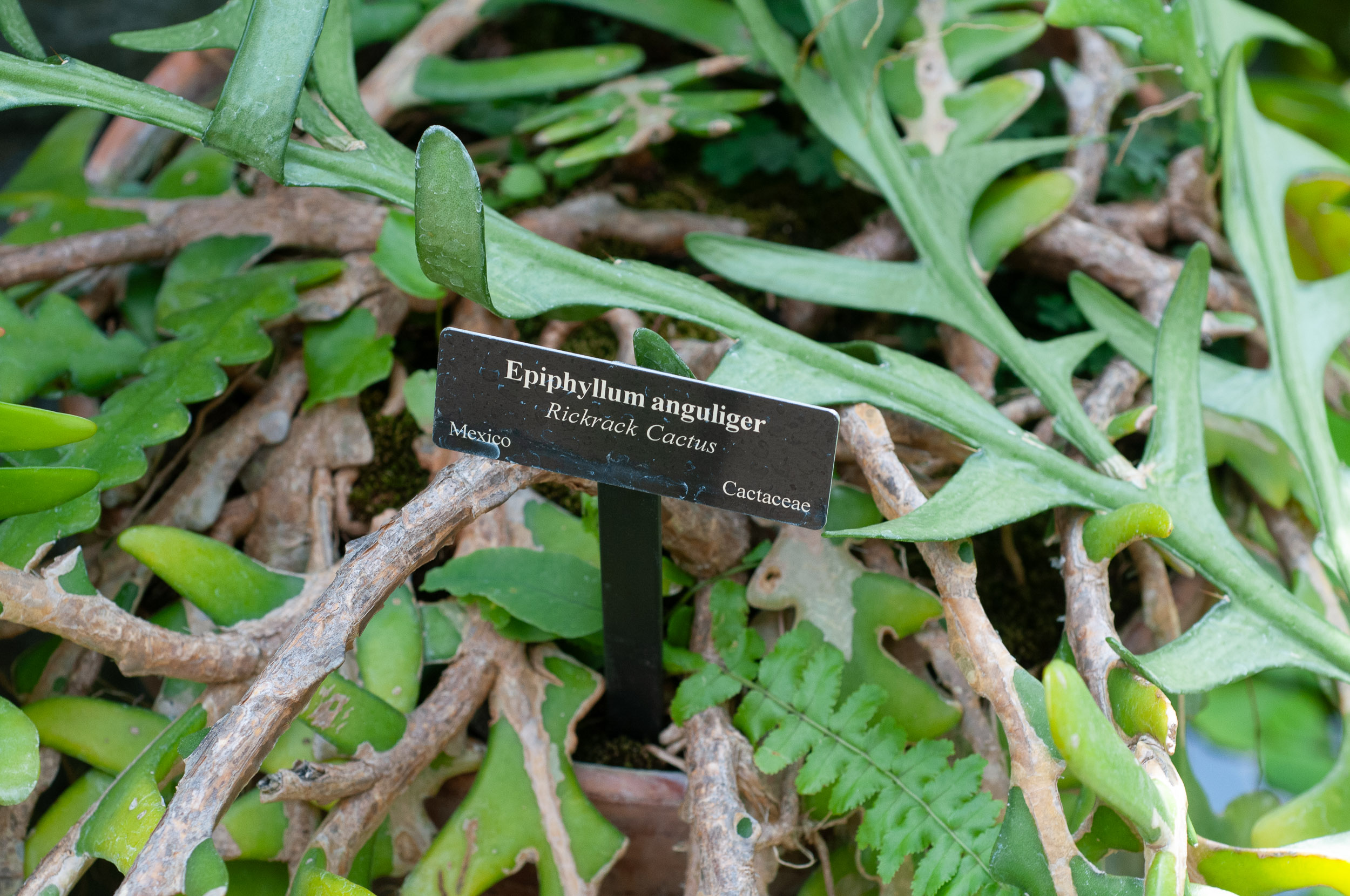
4/6/2011 · Howard Peters Rawlings Conservatory & Botanic Gardens, Druid Hill Park, Baltimore, Maryland · ≈ 12 × 8″ (31 × 20 cm) 
| Kingdom | Plantae | Plants, but not fungi, lichens, or algae (from Stearn's Botanical Latin) |
| Subkingdom | Tracheobionta | Vascular plants—plants with a “circulatory system” for delivering water and nutrients |
| Division | Magnoliophyta | Flowering plants, also known as angiosperms |
| Class | Magnoliopsida | Dicotyledons—plants with two initial seed leaves |
| Subclass | Caryophyllidae | Cacti, many other succulents, carnivorous plants, and leadworts |
| Order | Caryophyllales | Includes cacti, carnations, amaranths, ice plants, and many carnivorous plants |
| Family | Cactaceae | Succulent (water-storing) plants, often spiny |
| Genus | Epiphyllum | From Greek ἐπί (epí), “upon””, and φύλλο (phúllo), “leaf,” referring to its flowers borne on leaflike phylloclades |
| Species | anguliger | From anguliger, “angle bearing,” for the deeply toothed stems |
Epiphyllum anguliger description by Thomas H. Kent, not updated.

© FloraFinder.org. All rights reserved.
