Dioon edule β latipinna
Dioon mejiae Standley et L.O. Williams
Cycad
These large cycads are native to Honduras and Nicaragua.
Plants: These cycads are among the largest and most abundant in the world, reaching 24′ (7.3 m) in height, and 7–14″ (17–36 cm) around.
Leaves: The tree’s crown is topped by leaves emerging from the trunk center, 3–6½′ (1–2 m) long. Leaves have smooth edges.
Fruits: Male cones are spindle-shaped and pale brown, while female cones are large, ovoidal, acuminate, and greenish gray to pale brown. Cones are large, over 1′ (30 cm) long.
Habitats: Subtropical. An understory component of semi-deciduous tropical rain forest, found on steep slopes and in canyons, and also on flat terrain. Some populations thrive in sandy soil or sandy to clayey alluvial deposits, while others grow in loamy, limestone-derived soils; on in decomposed granite rich in humus. It occurs at elevations of 869–1640′ (265–500 m).
Edibility: Starch extracted from the seeds is a staple food. The seeds are not, until processed.
Online References:
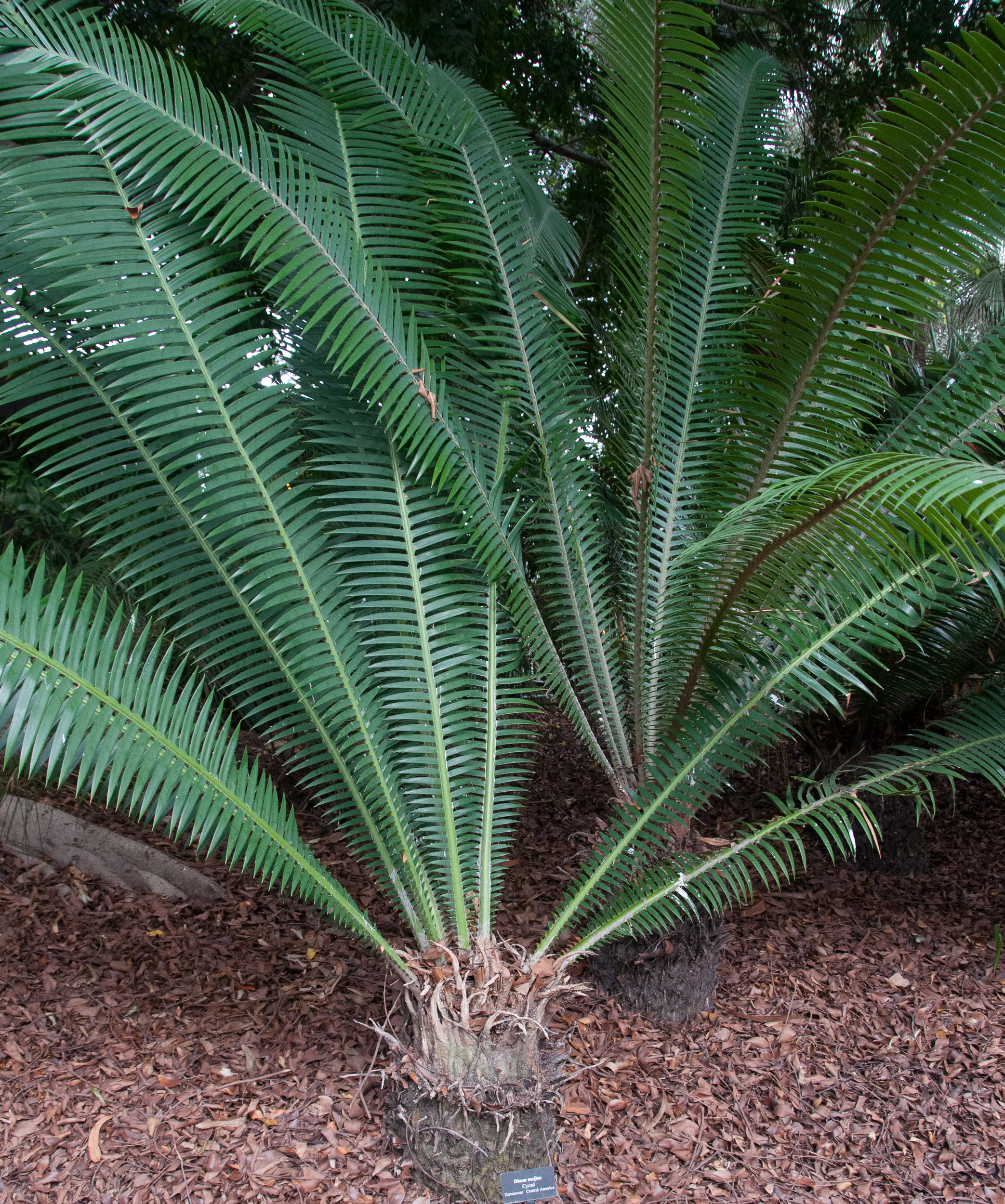
2/26/2010 · San Diego Zoo, San Diego, California · ≈ 4 × 5′ (1.3 × 1.6 m) 
| Kingdom | Plantae | Plants, but not fungi, lichens, or algae (from Stearn's Botanical Latin) |
| Subkingdom | Tracheobionta | Vascular plants—plants with a “circulatory system” for delivering water and nutrients |
| Division | Cycadophyta | All cycads—primitive palm-like plants |
| Class | Cycadopsida | Cycads |
| Order | Cycadales | Living cycads (most are extinct) |
| Family | Zamiaceae | Cycas that are superficially palm- or fernlike |
| Genus | Dioon | New Latin, from di- + -oön (from Greek ōion, ”egg”), for the two ovules produced in female cones |
| Species | mejiae | Honoring Dr. Isidoro Mejia H. (?–1950), physician in Danlí, El Paraíso, Honduras, from whose garden the type specimen was collected. |
Dioon mejiae description by Thomas H. Kent, not updated.

© FloraFinder.org. All rights reserved.
