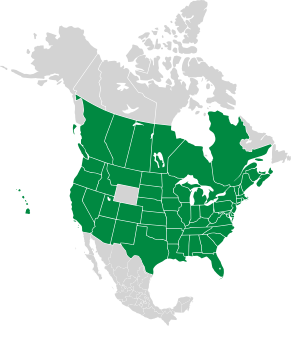
Datura tatula L.
Datura stramonium L.
Jimson weed, devil’s trumpet, devil’s weed, thorn apple, tolguacha, Jamestown weed, stinkweed, locoweed, datura, pricklyburr, devil’s cucumber, hell’s bells, moonflower, Jimsonweed
Datura stramonium has many faces. It’s a weed! It’s a poison! It’s a medicine! It’s a recreational drug! It’s a pretty flower! It’s a munitions dump purifier! “Loco weed” refers to this species’ ability to induce delirium and hallucinations in people, but there are unrelated plants also called locoweeds, including members of Oxytropis and Astralagus in North America, that are toxic to animals. Sources differ as to whether jimsonweed is native to North America or imported from the Old World. “Jimsonweed” is a corruption of “Jamestown weed”—read on to find out what happened to a group of Jamestown settlers who sampled the plant.

Flowers are trumpet-shaped when fully opened, but often look more like this. 
Plants: This non-woody bush grows to 3–5′ (91–152 cm) in height, with stiff, hollow stems that are green or purple.
Leaves: Toothed, wrinkly leaves are 3–8 ⨉ 1–6″ (7.6–20 ⨉ 2.5–15 cm).
Flowers: Large, attractive, trumpet-shaped, and pleasant-smelling, though the plant is malodorous. Flowers are 2½–3½″ (6.3–8.9 cm) long, white, cream-colored, purple, or white with a purple center. They usually open only partially, unfurling to produce a spiral, pinwheel-like effect.
Fruits: Densely thorny egg-shaped capsule 1–3″ (3–8 cm) long, consisting of four segments, and containing many dark brown or black seeds.
Habitats: Grows abundantly in warm and temperate regions.
Edibility: Poisonous  All parts of this plant contain a witch’s brew of
tropane alkaloids, a mixture that varies
in potency by as much as a factor of two, and a mixture that changes depending upon the age of the plant.
These alkaloids can cause poisoning, semi-blindness or impaired vision (lasting a week
or more), depressed breathing,
delirium and fever, loss of short term memory, and
hallucinations. In addition to many other symptoms, it is a vasodilator; it dries mucous membranes uncomfortably; and it causes tachycardia (very fast heartbeats).
Sometimes the leaves are confused with spinach leaves. Animals
typically avoid this species because of its strong odor and unpleasant taste.
All parts of this plant contain a witch’s brew of
tropane alkaloids, a mixture that varies
in potency by as much as a factor of two, and a mixture that changes depending upon the age of the plant.
These alkaloids can cause poisoning, semi-blindness or impaired vision (lasting a week
or more), depressed breathing,
delirium and fever, loss of short term memory, and
hallucinations. In addition to many other symptoms, it is a vasodilator; it dries mucous membranes uncomfortably; and it causes tachycardia (very fast heartbeats).
Sometimes the leaves are confused with spinach leaves. Animals
typically avoid this species because of its strong odor and unpleasant taste.
Medical: Toxic plants, by virtue of the fact that they effect the body at all, can often be adapted for medicinal purposes, and this species is no exception. Medications derived from its several active ingredients can treat cholinergenic overdose, urinary tract infections, premenstrual syndrome, heart ailments, and dilate your eyes at eye exams. Historically, scopolamine was used to “treat” pregnant women during labor. It wasn’t much help, but the short term amnesia it created erased memories of the pain.
Jimsonweed is sometimes used as a recreational drug, but the potency varies and the threshold between a safe dose and a lethal dose is unpredictable. It is often described as a deliriant rather than a hallucinogen, since it induces very unpredictable behavior. In anthropologist Carlos Castaneda’s books, the first of which is The Teachings of Don Juan: A Yaqui Way of Knowledge, he describes his experiences with this drug, given to him by a Yaqui Indian shaman.
Here is an account by Robert Beverly of Jamestown settlers’ experiences, from The History and Present State of Virginia, in Four Parts:
| The James-Town Weed (which resembles the Thorny Apple of Peru, and I take to be the Plant so call’d) is supposed to be one of the greatest Coolers in the World. This being an early Plant, was gather’d very young for a boil’d Salad, by some of the Soldiers sent thither, to pacifie the Troubles of Bacon; and some of them eat plentifully of it, the Effect of which was a very pleasant Comedy; for they turn’d natural Fools upon it for several Days: One would blow up a Feather in the Air; another wou’d dart Straws at it with much Fury; and another stark naked was sitting up in a Corner, like a Monkey, grinning and making Mows at them; a Fourth would fondly kiss, and paw his Companions, and snear in their Faces, with a Countenance more antick, than any in a Dutch Droll. In this frantick Condition they were confined, lest they should in their Folly destroy themselves; though it was observed, that all their Actions were full of Innocence and good Nature. Indeed, they were not very cleanly; for they would have wallow’d in their own Excrements, if they had not been prevented. A Thousand such simple Tricks they play’d, and after Eleven Days, return’d to themselves again, not remembring any thing that had pass’d. |
 |
These varieties of Datura have similar ranges and psychoactive effects, and they are often confused. |
Explosive Clearing Agent: If your yard should happen to be filled with leftover TNT (yes, the explosive, 2,4,6-trinitrotoluene), you’ll be pleased to know that this species has a unique talent for clearing it, by converting it into harmless by-products.
Online References:
References:
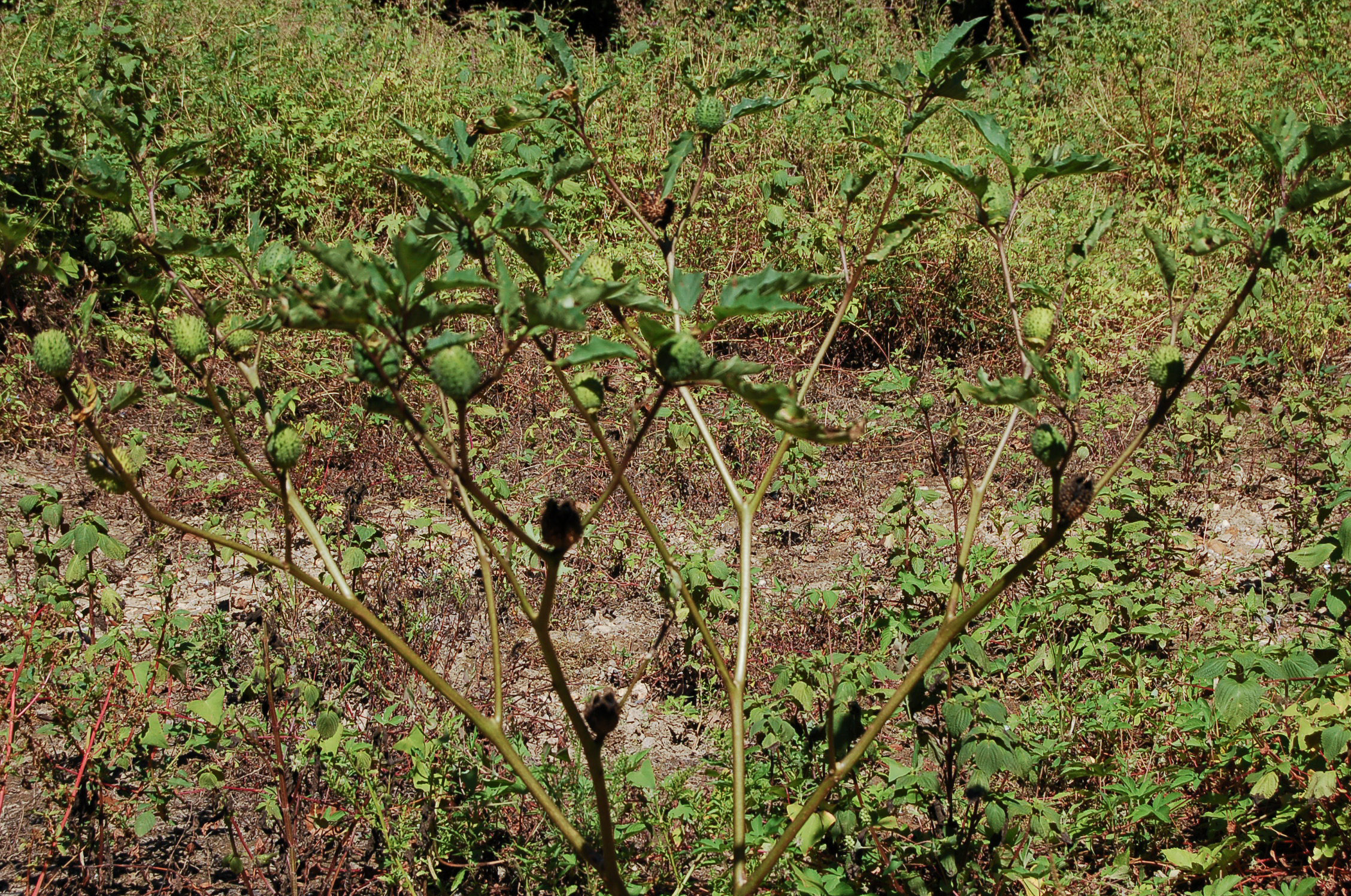
9/1/2008 · By Jacquelyn Boyt 
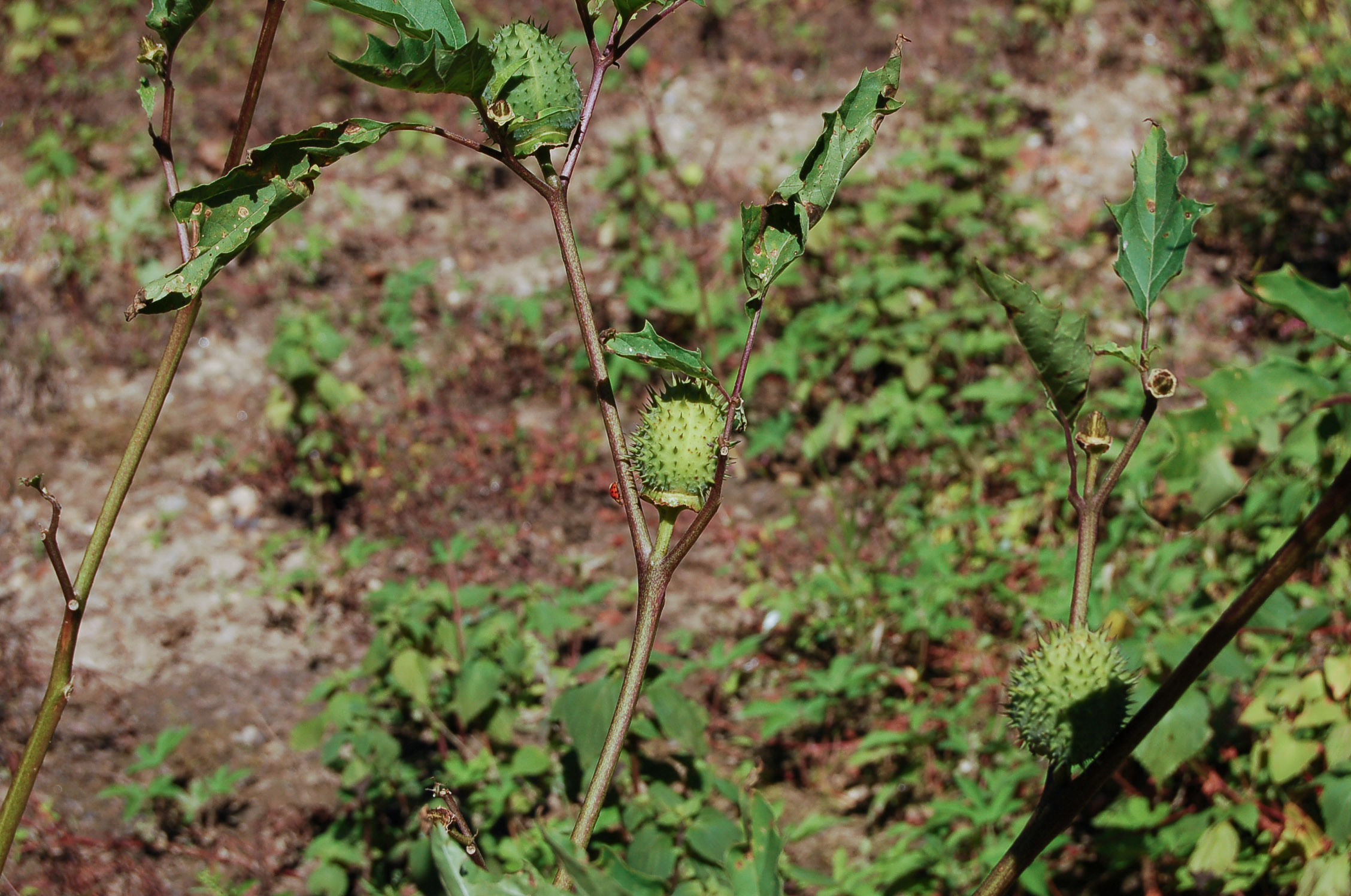
9/1/2008 · By Jacquelyn Boyt 
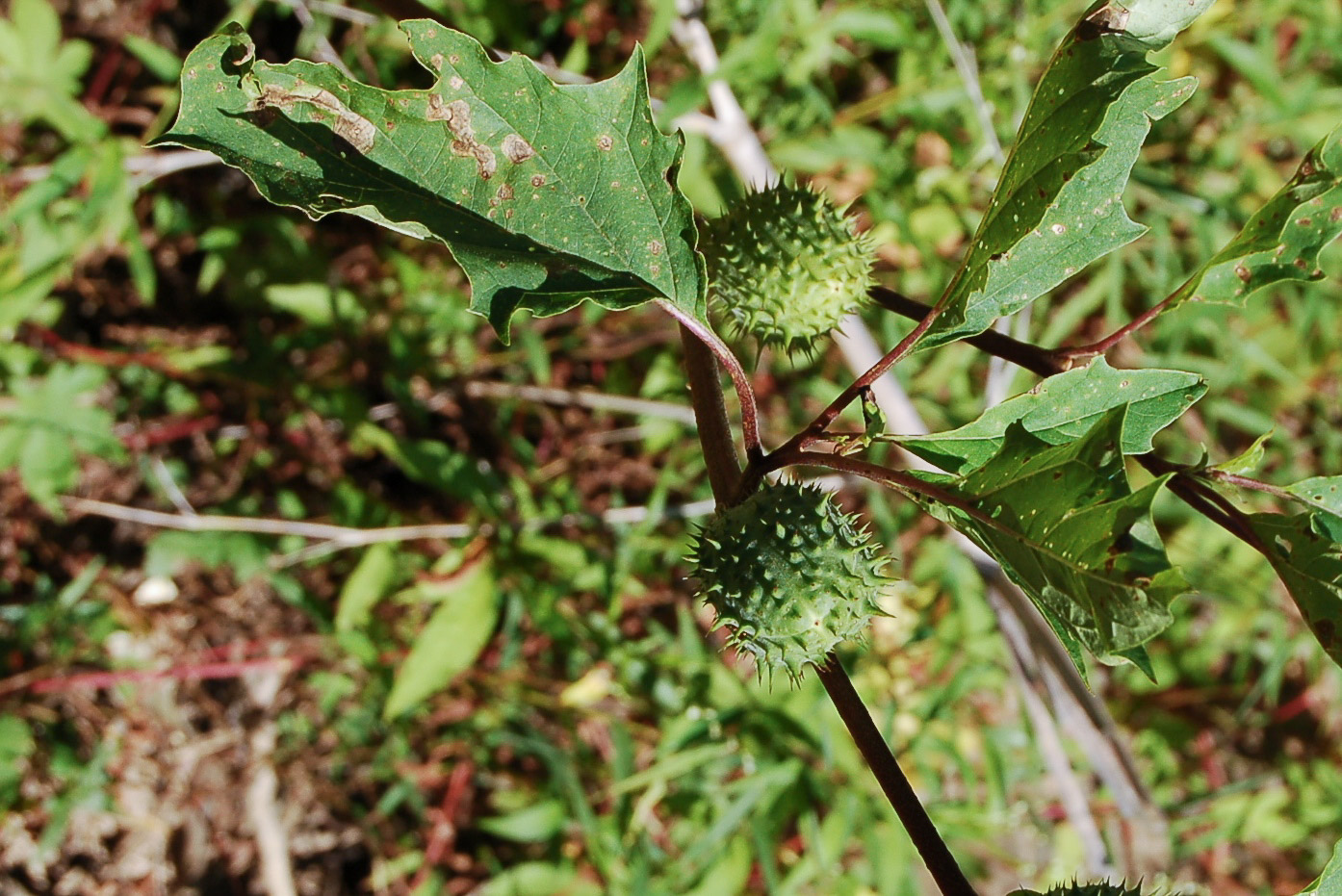
9/1/2008 · By Jacquelyn Boyt 
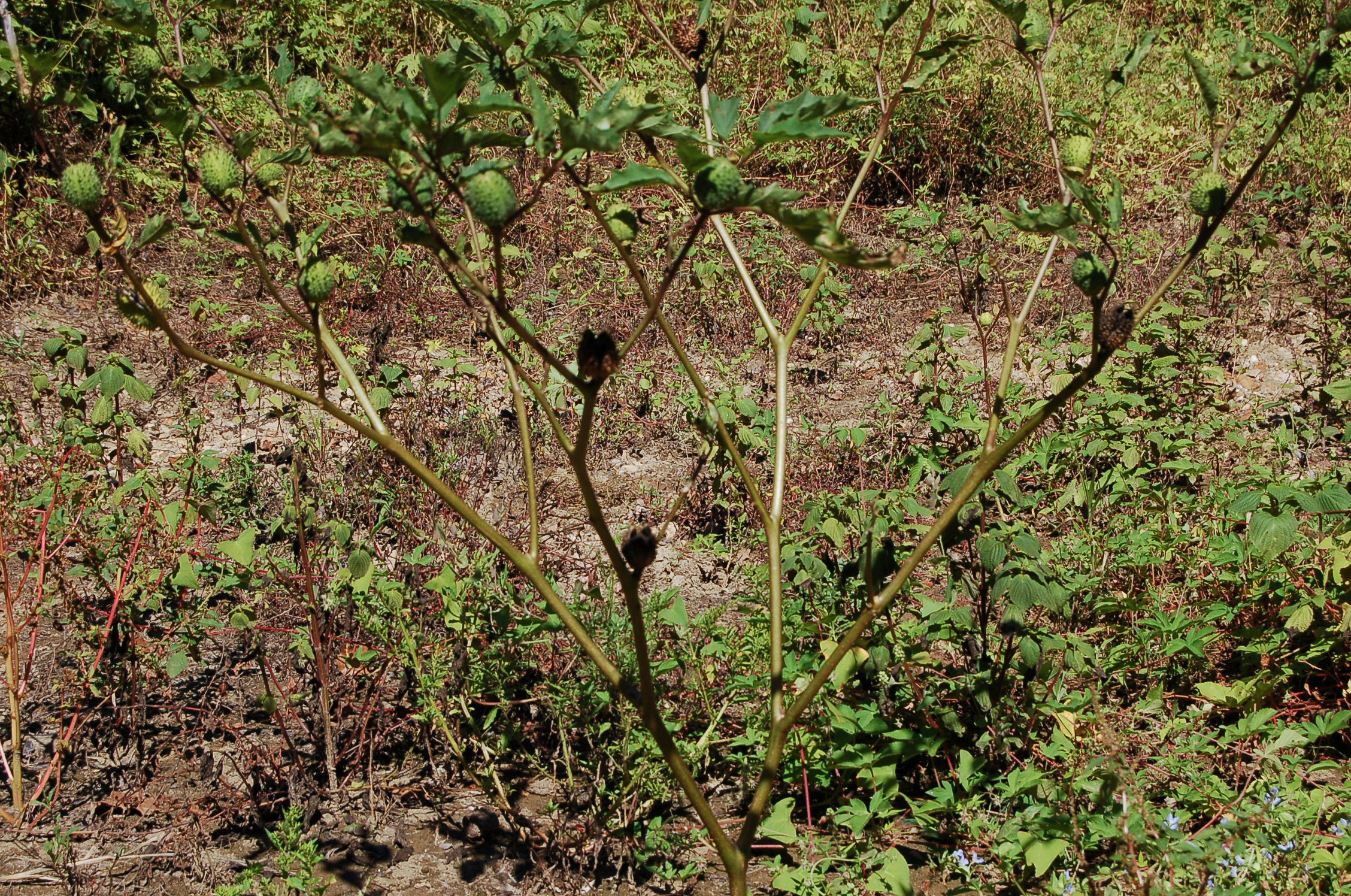
9/1/2008 · By Jacquelyn Boyt 
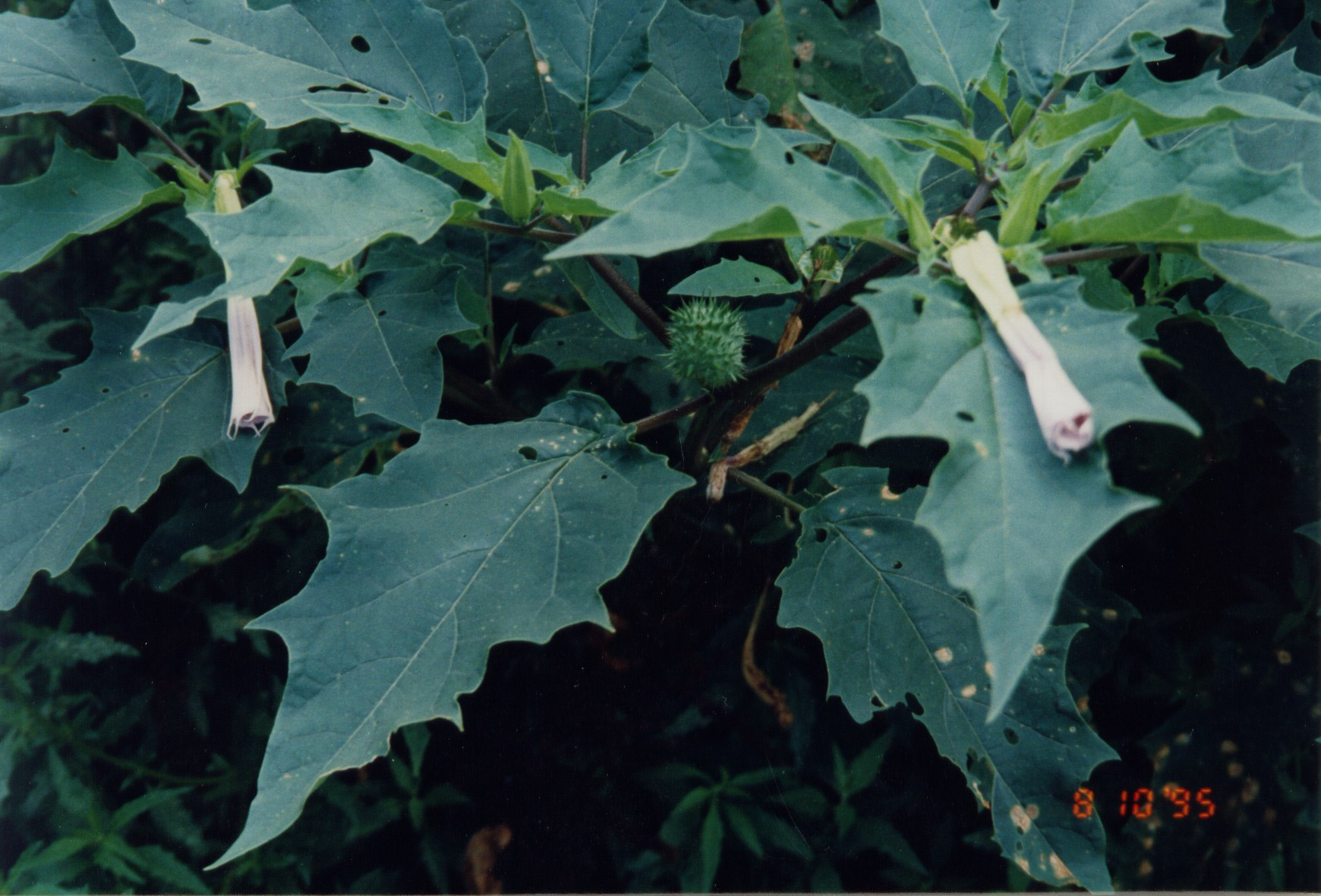
8/10/1995 · King George County, Virginia · By Tim Chandler  ID is uncertain
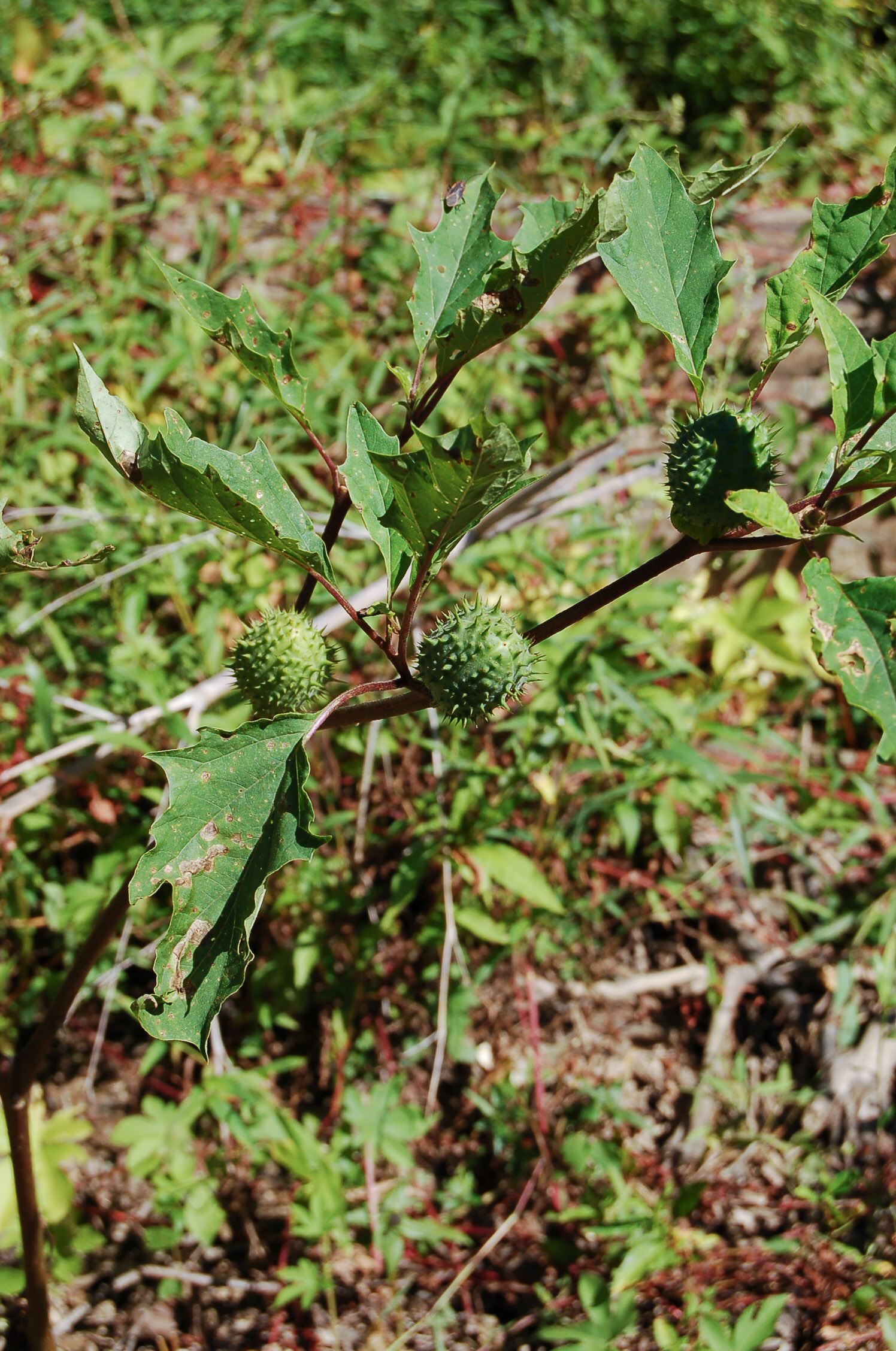
9/1/2008 · By Jacquelyn Boyt 
| Kingdom | Plantae | Plants, but not fungi, lichens, or algae (from Stearn's Botanical Latin) |
| Subkingdom | Tracheobionta | Vascular plants—plants with a “circulatory system” for delivering water and nutrients |
| Division | Magnoliophyta | Flowering plants, also known as angiosperms |
| Class | Magnoliopsida | Dicotyledons—plants with two initial seed leaves |
| Subclass | Asteridae | A large class that encompasses asters |
| Order | Solanales | Potatoes, eggplants, tomatoes, peppers, tobacco, petunias, sweet potatoes, morning glories, many others |
| Family | Solanaceae | Nightshade or potato family |
| Genus | Datura | From dhatura, an ancient Hindu word for a plant |
| Species | stramonium | Spiky-fruited, and a name used by Theophrastus for the thorn-apple |
Datura stramonium description by Thomas H. Kent, not updated.

© FloraFinder.org. All rights reserved.