Cephalanthus occidentalis L. var. pubescens Raf.
Cephalanthus occidentalis L.
Buttonbush, button-willow, honey-bells, common buttonbush
This plant’s cool-looking flowers fascinate me, and make for easy identification. Buttonbush is a North American native.
Plants: This deciduous shrub is 3–9½′ (1–3 m) high, rarely reaching 20′ (6 m). with many dense branches.
Leaves: Glossy, dark green, opposite or in groups of three, and up to 8″ (20 cm) long. Flowers begin life as bumpy light green balls about ¾″ (2 cm) in diameter.
Flowers: Buttonbush flowers look so unusual at every stage of development, and are visible during so much of the summer, that this alone is usually enough to identify the plant. Minute horn-shaped white or pale yellow flowers cover the surface, extending tiny sepal-bearing pistils. The flowerheads look like perfectly spherical softly bristled cream-colored balls up to 1¼″ (3.5 cm) around, each on a long stem (petiole).
Fruits: As the flowers age, they form hard brown seed balls—clusters of achenes—that look like bumpy brown cherries.
Habitats: Wet areas such as lakeshores and habitats that are at least sometimes flooded, including swamps, river edges, and the Everglades.
Edibility: Poisonous  This shrub is poisonous to livestock.
Online References:

7/11/2013 · Nashua River Rail Trail, Groton Center, Groton, Massachusetts · ≈ 5 × 4″ (13 × 11 cm) 

7/11/2013 · Nashua River Rail Trail, Groton Center, Groton, Massachusetts · ≈ 5 × 3½″ (12 × 9.4 cm) 

4/14/2015 · Anhinga Trail, Everglades National Park, Florida · ≈ 4½ × 3″ (11 × 7.9 cm) 

This flower is past its prime. · 7/30/2017 · Jason’s Cutoff and Nearby Trails, Beaver Brook Conservation Area, Hollis, New Hampshire · ≈ 6 × 4″ (15 × 10 cm) 

7/9/2010 · Nashua River Rail Trail, Groton Center, Groton, Massachusetts · ≈ 3½ × 3″ (8.8 × 7.9 cm) 

7/3/2012 · By Jacquelyn Boyt 

7/16/2010 · Nashua River Rail Trail, Groton Center, Groton, Massachusetts · ≈ 11 × 7″ (27 × 18 cm) 

7/27/2010 · Nashua River Rail Trail, Groton Center, Groton, Massachusetts · ≈ 11 × 8″ (28 × 20 cm) 

7/16/2010 · Nashua River Rail Trail, Groton Center, Groton, Massachusetts · ≈ 9 × 6″ (23 × 15 cm) 

9/11/2011 · Nashua River Rail Trail, Groton Center, Groton, Massachusetts · ≈ 2 × 2½″ (5.7 × 6.9 cm) 

4/11/2015 · Big Cypress Bend, Fakahatchee Strand Preserve State Park, Florida · ≈ 12 × 10″ (30 × 25 cm) 

8/30/2010 · Old RR bed near Wilkins Farm, Pepperell, Massachusetts · ≈ 7 × 4½″ (17 × 11 cm) 

10/23/2010 

The white spots on the leaves is Aceria cephalanthi, buttonbush mite · 9/2/2017 · Rocky Ridge Trail, Beaver Brook Conservation Area, Hollis, New Hampshire · ≈ 5 × 3½″ (12 × 9.2 cm) 

4/11/2015 · Big Cypress Bend, Fakahatchee Strand Preserve State Park, Florida · ≈ 10 × 7″ (25 × 16 cm) 

4/11/2015 · Big Cypress Bend, Fakahatchee Strand Preserve State Park, Florida · ≈ 10 × 7″ (25 × 16 cm) 

7/16/2010 · Nashua River Rail Trail, Groton Center, Groton, Massachusetts · ≈ 6 × 4″ (15 × 10 cm) 
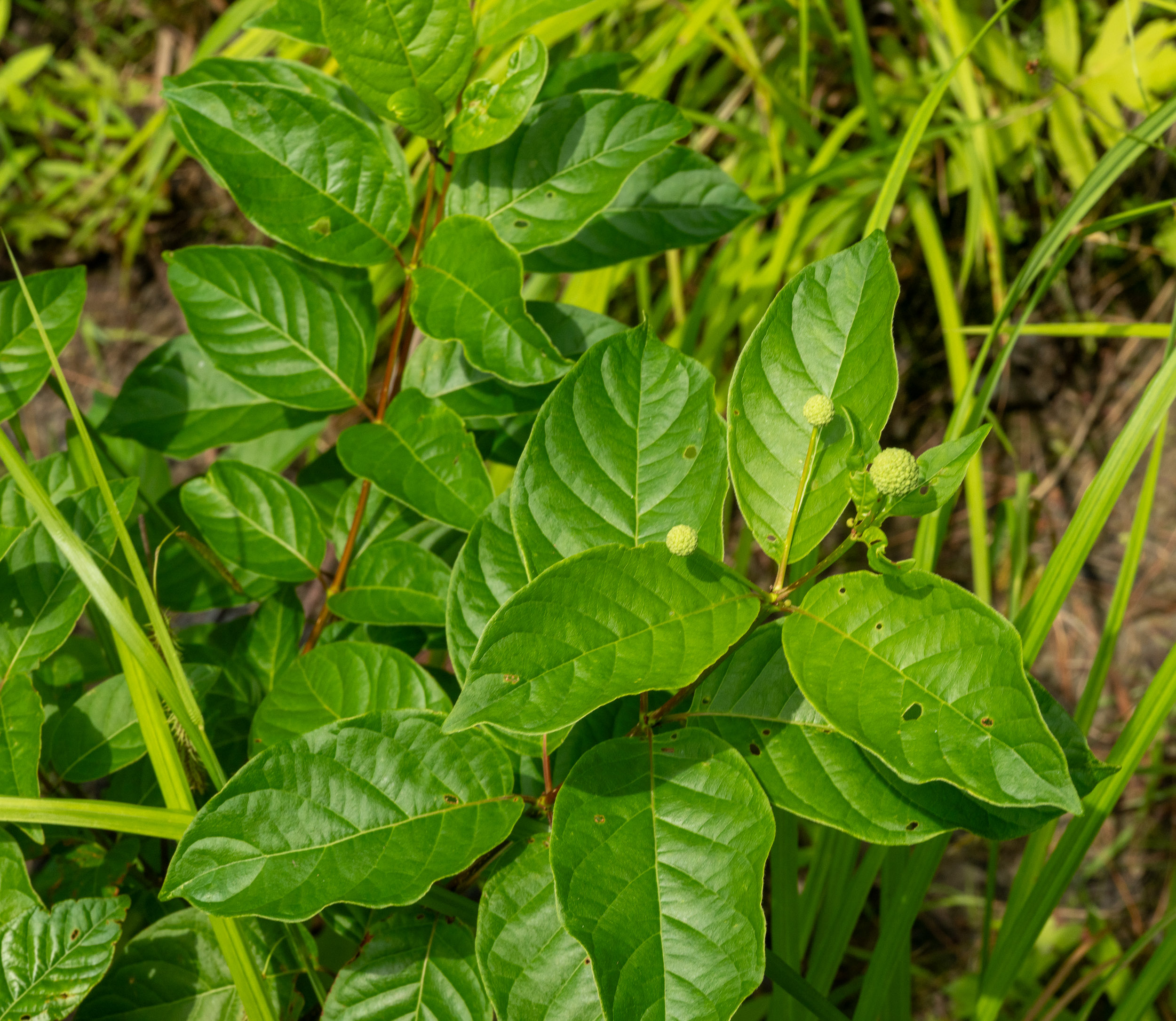
7/6/2026 · Head of Tide Park, Topsham, Maine · ≈ 12 × 11″ (31 × 27 cm) 

7/16/2010 · Nashua River Rail Trail, Groton Center, Groton, Massachusetts · ≈ 8 × 5″ (19 × 13 cm) 
| Kingdom | Plantae | Plants, but not fungi, lichens, or algae (from Stearn's Botanical Latin) |
| Subkingdom | Tracheobionta | Vascular plants—plants with a “circulatory system” for delivering water and nutrients |
| Division | Magnoliophyta | Flowering plants, also known as angiosperms |
| Class | Magnoliopsida | Dicotyledons—plants with two initial seed leaves |
| Subclass | Asteridae | A large class that encompasses asters |
| Order | Gentianales | Gentians, coffee, gardenias, frangipani, many others |
| Family | Rubiaceae | Coffee, madder, and bedstraw family |
| Genus | Cephalanthus | From the Greek kephale, “head,” and anthos, “flower,” the flowers are borne in compact rounded heads like those of a chrysanthemum or dahlia |
| Species | occidentalis | From the west, western |
Cephalanthus occidentalis description by Thomas H. Kent, not updated.

© FloraFinder.org. All rights reserved.
