Cedrus atlantica ‘Glauca Pendula’
Atlas cedar
The atlas cedar is so named because it is native to the Atlas mountains in Algeria and Morocco. They do not occur in the wild in North America, though they are planted in yards.
Plants: These cedars reach up to 120′ (36 m) in the Atlas mountains, but are usually 3–12′ (91–365 cm) in size when planted in North American gardens. This cultivar has needles with a blue/gray/green color, and a low, mounded shape, remaining only a few feet high.
Leaves: Needles are 1′ (30 cm), tightly clustered, and curved toward the tips.
Fruits: Female cones are ovoid to cylindrical in shape and up to 3″ (7.6 cm) long.
Habitats: Deep, well-drained acidic loams.
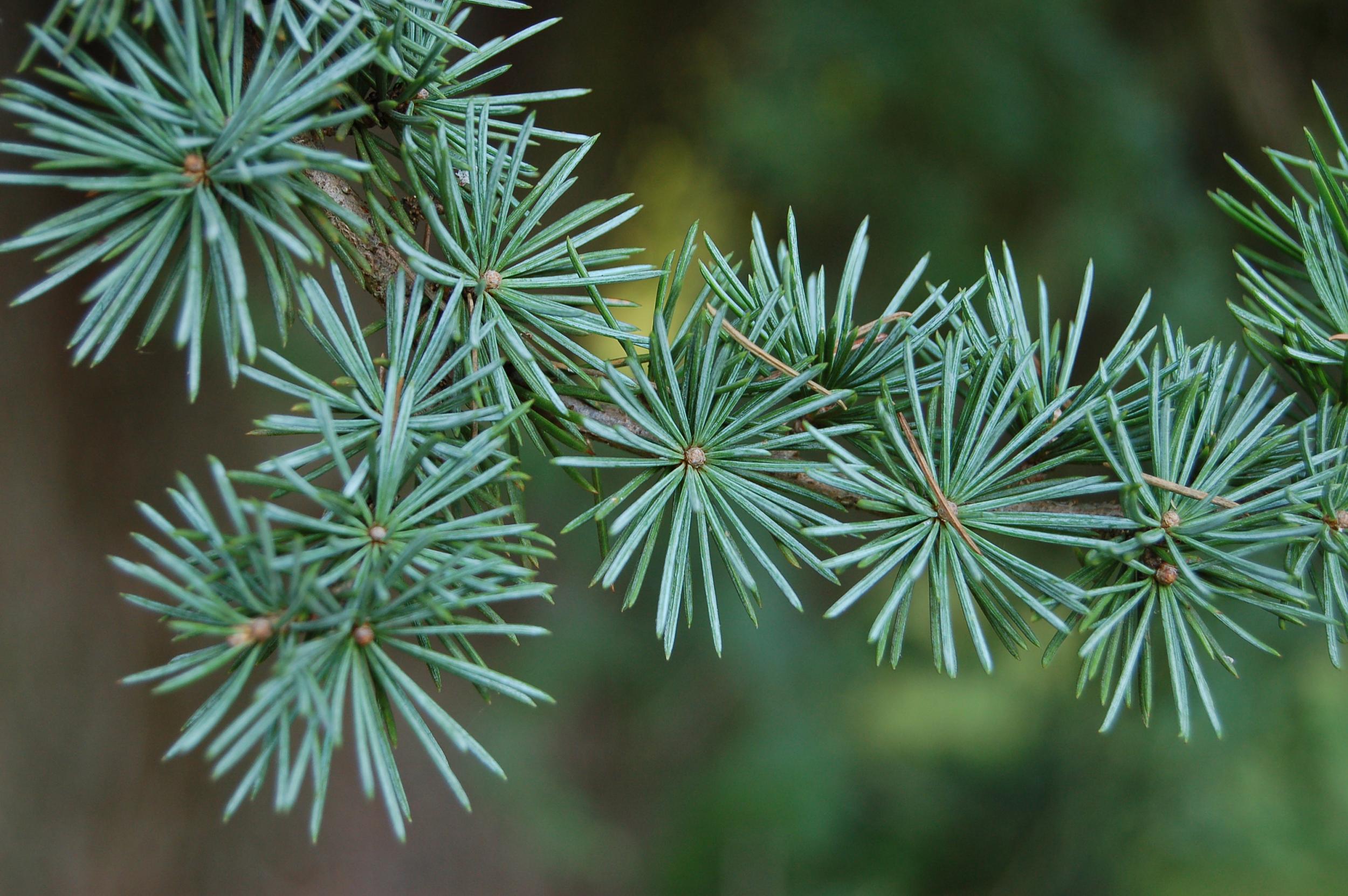
Photo showing Cedrus atlantica needles, by and © 2007 Derek Ramsey (Ram-Man) 
Online References:

9/7/2010 · New England Botanic Garden at Tower Hill, Boylston, Massachusetts 

9/7/2010 · New England Botanic Garden at Tower Hill, Boylston, Massachusetts · ≈ 2 × 1′ (62 × 41 cm) 
| Kingdom | Plantae | Plants, but not fungi, lichens, or algae (from Stearn's Botanical Latin) |
| Subkingdom | Tracheobionta | Vascular plants—plants with a “circulatory system” for delivering water and nutrients |
| Division | Coniferophyta | Conifers—cone-bearing trees (and a few shrubs) |
| Class | Pinopsida | Gymnosperms such as cedars, Douglas-firs, cypresses, firs, junipers, kauri, larches, pines, hemlocks, redwoods, spruces, and yews |
| Order | Pinales | Cone-bearing plants: cedar, cypress, fir, juniper, larch, pine, redwood, spruce, yew, and others |
| Family | Pinaceae | Pine family: cedars, firs, hemlocks, larches, pines and spruces |
| Genus | Cedrus | From Greek Κέδρος, “cedar” |
| Species | atlantica | Atlantic, of the Atlantic |
Cedrus atlantica ‘Glauca Pendula’ description by Thomas H. Kent, not updated.

© FloraFinder.org. All rights reserved.