Carex arctata Boott ex Hook.
Drooping wood sedge, drooping woodland sedge
Similar species
Carex arctata
Carex gracillima


|
Carex arctata Boott ex Hook. Drooping wood sedge, drooping woodland sedge Similar species | ||
| You are here Carex arctata |
Carex gracillima |
|
|---|---|---|
| Common Name | |
|
| Plant | Occurring in dense tufts, plants are up to 3′ (1 m) high. | 8–36″ (20–91 cm) high. |
| Leaves | Basal or nearly so. Grasslike leaves are ⅛–⅜″ (3–10 mm) wide. At the base, they are encased in a sheath that is pink to reddish purple. Younger leaves have an ‘M’ or ‘W’-shaped cross-section. | Basal, ⅛–⅜″ (3–10 mm) wide, and alternate. Leaves may be smooth or rough in texture. A sheath at the base of the plant is often red or purple in color. |
| Flowers | Male (staminate) and female (pistillate) spikes are separate. The topmost spike is unisexual, staminate, ⅞–3 ⨉ 1/16–⅛″ (2.5–8 cm ⨉ 3–4 mm). 2-5 pistillate (also called carpellate) spikes appear lower on the stem. Each spike is up to 3″ (8 cm) long, and slender. Young spikes point upward, but they droop with age. | A stalk emerging above the leaves, 8–35″ (20–90 cm) long, contains both carpellate (seed-bearing) and staminate (pollen-bearing) flowers, with the carpellate ones uppermost. Each stalk has 2-5 spikes, each on a stem up to 1½″ (4 cm) long. Each spike is ⅜–2½″ (1–7 cm) × 1/16–⅛″ (2–3.5 mm) in size. |
| Fruit | Achenes are ~1/16″ long ⨉ 1/32–1/16″ wide (1.7–2.6 ⨉ 0.8–1.7 mm). | Carpellate spikes form seed clusters called achenes. Each such cluster is wrapped in a perigynium. They appear from late spring to mid-summer. |
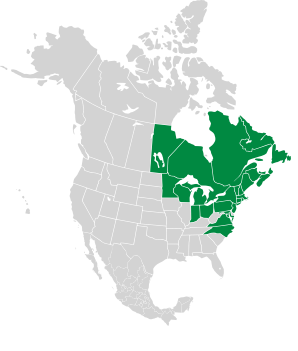
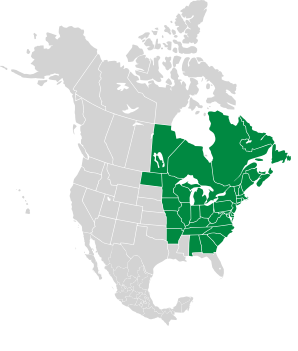
| Range/ Zones |
|
|
| Habitats | Rich, damp forested areas. | Common in damp forests and meadows |
Carex arctata description by Thomas H. Kent, not updated.
© FloraFinder.org. All rights reserved.