Bougainvillea glabra Choisy
Paperflower
The plant and genus are named in honor of the noted mathematician, scientist, lawyer, soldier, author and Royal Society Fellow, Louis Antoine de Bougainville (1729-1811). But de Bougainville actually “took notice” of the species, he didn’t discover it. It was discovered in Brazil by Jacques Denys Choisy, in 1850. Paperflower is a South American native, now naturalized in Texas and Florida in North America. There are many cultivars, and it is popular among gardeners and bonsai enthusiasts. They prefer full sun.
Plants: Evergreen woody climbing plants are 10–15′ (3–4.6 m), with hairy and thorny stems. Thorns are about ½″ (1.3 cm). They form freestanding bushes or climb like vines over walls and fences.
Leaves: 1–4″ (2.5–10 cm) long, elliptical, shiny, hairless, and alternate, with smoother edges than those of B. spectabilis. Sometimes the leaves are variegated.
Flowers: Bougainvilleas are kind of weird. Their flowers are cream-colored, about ⅜″ (1 cm) in diameter, with pleated edges. But the bracts (modified leaves) surrounding the flowers come in a range of (often cultivated) attractive colors: many reds, lavendar, magenta, peach, yellow, and white. If you look closely at the colorful “petals,” they are clearly leaves. In this species, the bracts tend to be more triangular in shape. Flowers appear several times per year, from winter to early spring.
Fruits: Five-lobed oblong achenes, about ⅜″ (1 cm) long and containing one seed only. They are rarely produced in cultivation.
Habitats: Dry tropical and subtropical climates, in full sun.
Medical: Many health-related benefits are attributed to bougainvilleas, but I cannot find any hard information on the topic.
 |
Similar species. |
Online References:

7/7/2007 · Guam · By Jacquelyn Boyt 

Bonsai. · 12/12/2016 · Bonsai West, Littleton, Massachusetts 
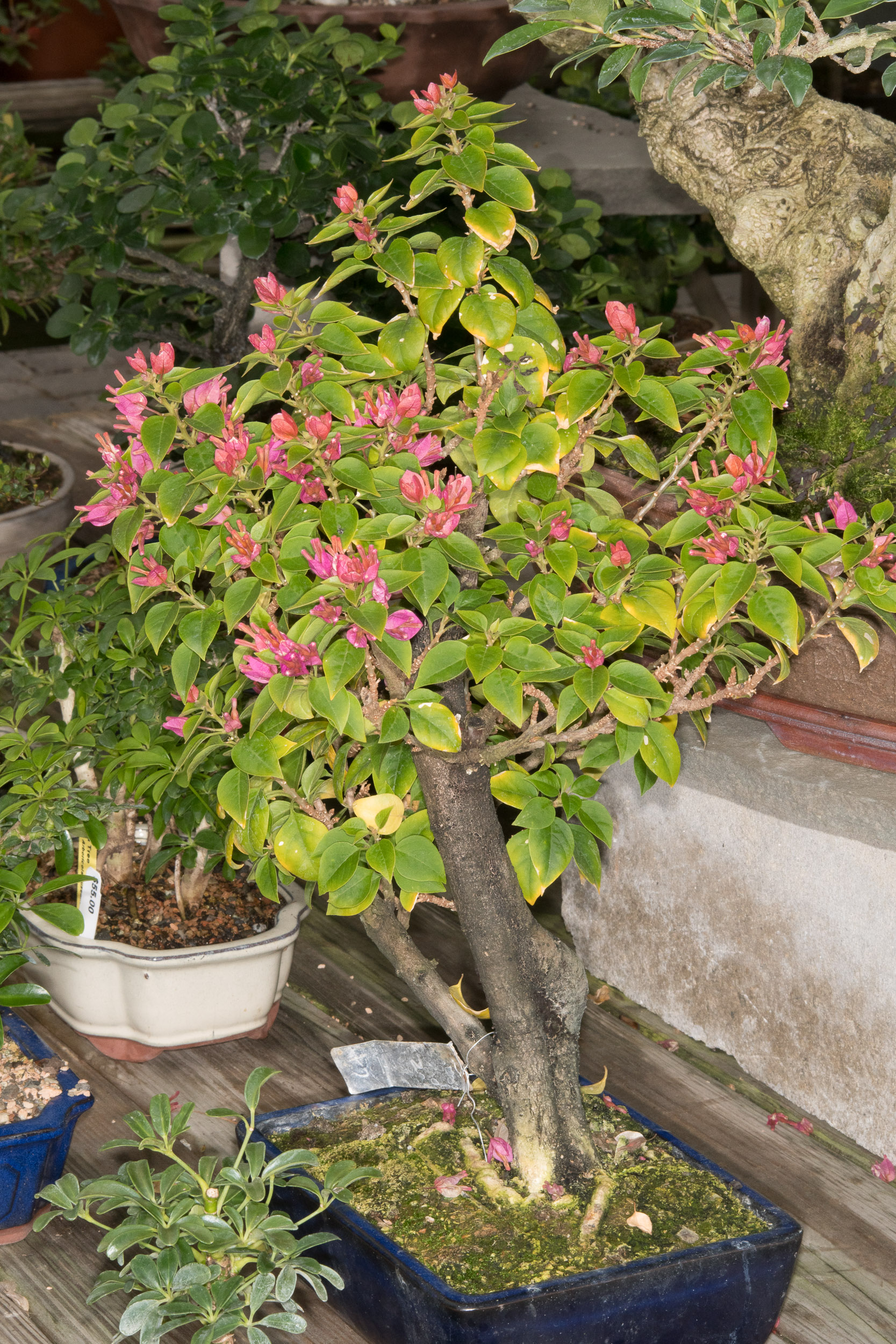
Bonsai. · 12/12/2016 · Bonsai West, Littleton, Massachusetts 

4/6/2011 · Howard Peters Rawlings Conservatory & Botanic Gardens, Druid Hill Park, Baltimore, Maryland · ≈ 11 × 7″ (27 × 18 cm) 

7/7/2007 · Guam · By Jacquelyn Boyt 

Bonsai. · 12/12/2016 · Bonsai West, Littleton, Massachusetts · ≈ 6 × 4″ (15 × 10 cm) 

Bonsai. · 12/12/2016 · Bonsai West, Littleton, Massachusetts · ≈ 1 × 1½′ (34 × 52 cm) 

Bonsai. · 12/12/2016 · Bonsai West, Littleton, Massachusetts 

4/6/2011 · Howard Peters Rawlings Conservatory & Botanic Gardens, Druid Hill Park, Baltimore, Maryland · ≈ 5 × 3½″ (13 × 9.2 cm) 

4/6/2011 · Howard Peters Rawlings Conservatory & Botanic Gardens, Druid Hill Park, Baltimore, Maryland · ≈ 1½ × 1′ (52 × 34 cm) 

2/24/1998 · Antigua  ID is uncertain


Bonsai. · 12/12/2016 · Bonsai West, Littleton, Massachusetts · ≈ 6 × 4″ (15 × 10 cm) 

Bonsai. · 12/12/2016 · Bonsai West, Littleton, Massachusetts · ≈ 6 × 4″ (16 × 11 cm) 

4/6/2011 · Howard Peters Rawlings Conservatory & Botanic Gardens, Druid Hill Park, Baltimore, Maryland · ≈ 5 × 8″ (13 × 19 cm) 

7/20/2007 · Guam · By Jacquelyn Boyt ID is uncertain 

7/7/2007 · Guam · By Jacquelyn Boyt 

4/9/2015 · MacDonald‘s, Marco Island, Florida · ≈ 7 × 4½″ (17 × 11 cm) 

4/6/2011 · Howard Peters Rawlings Conservatory & Botanic Gardens, Druid Hill Park, Baltimore, Maryland · ≈ 11 × 7″ (27 × 18 cm) 

Bonsai. · 12/12/2016 · Bonsai West, Littleton, Massachusetts · ≈ 10 × 15″ (26 × 39 cm) 

Bonsai. · 12/12/2016 · Bonsai West, Littleton, Massachusetts · ≈ 6 × 4″ (16 × 11 cm) 
| Kingdom | Plantae | Plants, but not fungi, lichens, or algae (from Stearn's Botanical Latin) |
| Subkingdom | Tracheobionta | Vascular plants—plants with a “circulatory system” for delivering water and nutrients |
| Division | Magnoliophyta | Flowering plants, also known as angiosperms |
| Class | Magnoliopsida | Dicotyledons—plants with two initial seed leaves |
| Subclass | Caryophyllidae | Cacti, many other succulents, carnivorous plants, and leadworts |
| Order | Caryophyllales | Includes cacti, carnations, amaranths, ice plants, and many carnivorous plants |
| Family | Nyctaginaceae | Plants with unique fruits (“anthocarps”) and large pollen grains |
| Genus | Bougainvillea | Named in honor of the noted mathematician, scientist, lawyer, soldier, author and Fellow of the Royal Society of London, Louis Antoine de Bougainville (1729-1811), who from 1767 to 1769 sailed around the world |
| Species | glabra | Smooth or hairless |

Bougainvillea glabra description by Thomas H. Kent, not updated.

© FloraFinder.org. All rights reserved.