Araucaria bidwillii (Molina) K. Koch
Bunya-bunya, bunya-bunya pine
The bunya pine, native to Queensland, Australia, is not found in the wild in North America. It is not actually a pine at all, though the mistake is a natural one, given its appearance and its cone-like nuts.
Plants: Trees are 98–148′ (30–45 m) high, and can reach 500 years in age. If you are in the Bunya Mountains, or the Jimna area, or Mount Lewis (all in Australia), look for tall trees with rounded tops (younger trees are more pyramidal in shape). Bark is dark brown or black, with scales that are about ⅞″ (2.5 cm) wide and 3″ (7.5 cm) long. The trunk resembles that of an elephant.
Leaves: Younger trees have glossy, stiff, light green leaves, ⅞–1¾″ (2.5–5 cm) long, with sharp points. Older trees have leaves that are darker, arrayed evenly about the small branches, ¼–1″ (7–28 mm) long.
Fruits: Cones appear on branch tips. Male (pollen) cones are spikes up to 8″ (20 cm) long. Female seed cones are up to 12 ⨉ 8″ (30 ⨉ 20 cm). Mature female cones are green, with 50-100 pointed segments, and weigh up to 10 kg.
Habitats: Mountains in southeast and northern Queensland, Austrailia, in montane rain forests on deep soils.
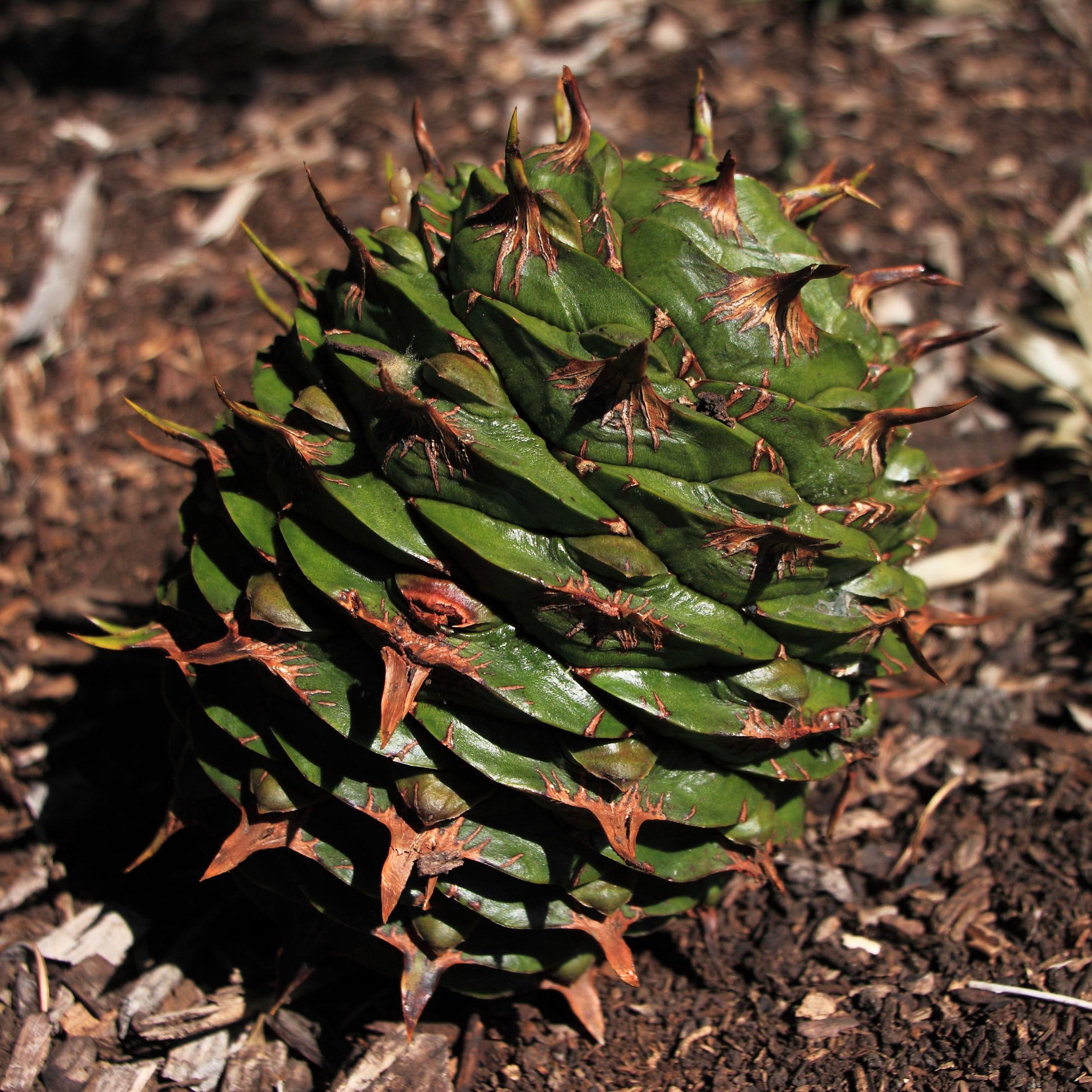
The conelike nuts were a significant food source for indigenous Australians. Photo by Dgies. 
Edibility: Roasted and boiled, the nuts were important to Australian natives. Paste made by grinding the nuts could be eaten as is or cooked into a bread. Nuts stored in a running creek fermented, producing a delicacy. More recently, enthusiasts have created many interesting preparations of this “bushfood,” which tastes like a cross between chestnuts and potatoes.
Online References:

2/24/2010 · San Diego (Quail) Botanic Garden, Encinitas, California  ID is uncertain


4/6/2011 · Howard Peters Rawlings Conservatory & Botanic Gardens, Druid Hill Park, Baltimore, Maryland 

4/6/2011 · Howard Peters Rawlings Conservatory & Botanic Gardens, Druid Hill Park, Baltimore, Maryland · ≈ 4½ × 7″ (11 × 17 cm) 

2/24/2010 · San Diego (Quail) Botanic Garden, Encinitas, California 

2/24/2010 · San Diego (Quail) Botanic Garden, Encinitas, California 

4/6/2011 · Howard Peters Rawlings Conservatory & Botanic Gardens, Druid Hill Park, Baltimore, Maryland 
| Kingdom | Plantae | Plants, but not fungi, lichens, or algae (from Stearn's Botanical Latin) |
| Subkingdom | Tracheobionta | Vascular plants—plants with a “circulatory system” for delivering water and nutrients |
| Division | Coniferophyta | Conifers—cone-bearing trees (and a few shrubs) |
| Class | Pinopsida | Gymnosperms such as cedars, Douglas-firs, cypresses, firs, junipers, kauri, larches, pines, hemlocks, redwoods, spruces, and yews |
| Order | Pinales | Cone-bearing plants: cedar, cypress, fir, juniper, larch, pine, redwood, spruce, yew, and others |
| Family | Araucariaceae | Araucarian family |
| Genus | Araucaria | Named for the South Chilean province of Arauco |
| Species | bidwillii | After John Carne Bidwill (1815-1853), a botanical collector of the 1840 – 1850 period. |

Araucaria bidwillii description by Thomas H. Kent, not updated.

© FloraFinder.org. All rights reserved.